
Quick Links
2025 kept us on our toes at every turn, and the pace of change will only quicken ahead. But before we turn the calendar, it’s worth taking a moment to reflect on 2025.
We accomplished so much as an industry.
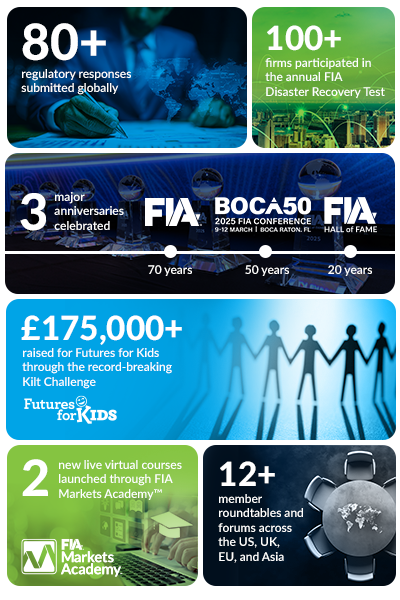
Working closely with our members and the various committees and working groups, we submitted more than 80 responses to consultations across the world.
We celebrated important milestones and anniversaries. 2025 marked 70 years of FIA, 50 years of Boca. 50 years of the CFTC. 20 years of the FIA Hall of Fame.
These are not just numbers – they are proof the cleared derivatives ecosystem adapts, innovates, evolves and endures.
More broadly than FIA, our markets performed impressively despite incredible volatility and uncertainty. This is a testament to our efforts over the past decade to strengthen resilience, develop standards, and work together to ensure customers have reliable, consistent access to our markets to hedge and manage risk.
So, thank you to our members and all those in our industry with whom we work every day.
Your involvement is what makes FIA effective, and we could not do it without you.
Walt Lukken, president and CEO of FIA
Reducing regulatory burden
In the US, UK and EU, the theme of reducing regulatory red tape and other burdensome rules permeated discussions in capital cities and at financial forums. FIA took ample opportunities to reiterate the position of advocating for fit-for-purpose regulations that bring fairness, clarity and predictability to our markets. Raising industry standards is part of FIA’s mission and smart regulation helps accomplish this.
Part of this advocacy included highlighting areas and specific duplicative rules that would free up capital and improve the efficiency of the markets.
Of course, this included countless discussions and several responses related to the EU’s Savings and Investment Union initiative.
FIA responded to ESMA on reducing reporting burdens. Our response identified key challenges with the existing framework and highlighted how best to eliminate duplication and streamline reporting. We also worked with other trade organisations to highlight burdensome issues.
And we came away with several wins as a result of our efforts, including when ESMA halted its ongoing review of the MiFIR reporting regime to allow for a holistic review of EU reporting obligations.
Where capital has featured prominently with policymakers in the past year, the new US Administration and Congress reset the conversation. As a result, we saw global regulators revisit the more burdensome standards to varying degrees, depending on the country. Nothing crossed the finish line in 2025, but we set many of our priorities up for significant progress in 2026. This includes a review of the US Basel III endgame rules and a revision of the BCBS rules on exposure to crypto assets.
FIA also spent the year working with other trades to advocate for cross product netting under the bank capital rules in the US. While we originally advocated for such an offset for the launch of US Treasury clearing, we now seek this netting where there is a qualified cross-product netting arrangement with counterparties in place. Recognising offsetting risk in the capital framework would expand banks’ ability to intermediate in capital markets.
Read more about FIA's key work areas in 2025...









Operations, Technology and Industry Resilience
Despite the significant volatility in our markets due to geopolitical events, markets continued operating normally. That is a testament to the hard work focused on resilience we have put in for years.
FIA standards body, DMIST, continued to tackle ways to bring efficiencies to the market structure of our industry by approving its third and fourth standards, on position transfers and self-match prevention, respectively. It also released three consultation papers and two implementation guides to promote and support adoption of the current standards.
As a result of these efforts, we are seeing materially fewer backlogs in unallocated trades during volatile periods. In April, during President Trump’s announcement on tariffs, misallocated trades dropped by nearly 50% compared to the Ukraine peak. While we are not declaring victory, these standards are making the difference we envisioned five years ago.
Looking ahead to 2026, DMIST will focus on three strategic pillars: continuing to develop standards for current market structures and workflows, increasing emphasis on structured implementation phases for published standards, and formalising efforts around horizon scanning to address emerging topics across the industry.
FIA strengthened industry resilience through proactive monitoring and collaboration. Our industry resilience committee and member groups actively assessed global incidents, supported by internal readiness processes, to share information and engage stakeholders. We partnered with financial sector organisations such as SIFMA and FSSCC to exchange critical insights and, when necessary, coordinated industry-wide responses.
Equally important, we successfully argued against the need for specific operational resilience rules that might conflict with the enterprise-wide management of resilience common in our markets, resulting in the CFTC withdrawal of overly restrictive proposed rules.
Another key achievement: developing and rollout out the FIA CCP Incident Response & Data Recovery Questionnaire, which will enhance recovery efficiency across the sector. Additionally, the annual FIA Disaster Recovery Test brought together more than 100 organisations – including exchanges, FCMs, service providers, brokers and vendors, underscoring our commitment to preparedness and operational continuity.
- FIA responds to EBA consultation on non-ICT third-party risks
- FIA responds to UK consultations on operational incident and third-party reporting
- Chair of the European T+1 Industry Committee welcomes the official launch of the governance structure for the transition to T+1 settlement cycle
- FIA publishes statement on the treatment of EU and non-EU regulated financial services under DORA
- FIA responds to European Commission consultation on revising EU Cybersecurity Act
- FIA responds to ECB consultation on extension of T2 operating hours
- FIA responds to UK consultations on operational incident and third-party reporting

Clearing and Trading
FIA continued its core advocacy work focused on clearing, trading, margin transparency, CCP recovery and resolution, as well CCP non-default loss issues.
In December, after many years of development, LCH Ltd (SwapClear) began to offer the FIA-developed European Agent Trustee Model (English model) that allows clearing members to adopt a US-style agency client clearing model for Europe. We expect this to bring significant capital efficiencies to participating GSIB clearing members. We also expect Eurex Clearing to offer the model in 2026.
On the US Treasury clearing mandate, FIA started the year by requesting a delay in the deadlines from the SEC, which the agency granted. Since then, FIA has taken a leadership role in the development of the client clearing models and related documentation. And throughout the year, we engaged with CME, ICE and FICC on a number of issues, including the FICC/CME cross-margining arrangements.
After several years of advocacy, in December, FIA received critical CFTC clarification on Part 30 regarding how FCMs post collateral to foreign CCPs, which is estimated to save our industry $22 billion in duplicative collateral.
In APAC, FIA’s sustained engagement with KRX on the risks of running night sessions over extended holiday periods delivered a positive outcome. At the KRX Member Forum held alongside FIA’s regional event in Busan, KRX confirmed it will not proceed with a night session under those circumstances.
FIA also achieved a major milestone in Hong Kong on position limits for Hang Seng Index derivatives. Following many years of coordinated advocacy by FIA and its members, the SFC raised the position limits with effect from 2 July 2025.
Throughout the year, FIA has been advocating for appropriate and transparent cleared margin. In January 2025, the Basel Committee on Banking Supervision, Committee on Payments and Market Infrastructures and International Organisation of Securities Commissions released a proposal on transparency and responsiveness of initial margin in centrally cleared markets. In June 2025, European Securities and Markets Authority issued its proposal on margin transparency technical requirements under EMIR 3.0. FIA worked with members to respond to both consultations.
Key activities included coordinating clearing member input by developing and executing a member survey on margin transparency to provide data into FIA’s submission, thus strengthening our advocacy message.
FIA is currently responding to a CPMI-IOSCO consultation on general business loss, due early February 2026. This consultation follows years-long advocacy that CCPs must hold minimum capital to cover non-default losses. The consultative report includes a positive development clarifying CCPs must compute liquid net assets funded by equity and use the six-month operating expense as a minimum value.
FIA responded to the Bank of England consultation paper on Ensuring the Resilience of CCPs. FIA recommended outlining porting and default management issues, proposing CCP margin transparency and anti-procyclicality clarifications, as well as strengthening the CCP margin model validation framework.
First published in 2012, the FIA Protection of Customer Funds FAQ has become a widely used resource for the industry. As updated for release in October 2025, the document contains 30 questions and answers addressing the basics of: FCM segregation of customer funds, collateral management and investments; minimum financial and other requirements for FCMs and dually registered FCM/broker-dealers; treatment of customer funds in the event of an FCM insolvency; and clearinghouse guarantee funds.
- FIA statement on EU equivalence for UK clearinghouses
- FIA responds to BoE on enhancing the resilience of the gilt repo market
- FIA responds to Bank of England consultation on CCP resilience
- FIA responds to ASIC consultation on market integrity rules
- FIA responds to ASX Consultation on Anomalous Order Thresholds for ASX 24 Products
- FIA responds to SEBI closing auction session proposal
- FIA responds to ESMA consultation on margin transparency requirements
- FIA responds to ESMA consultation on clearing fees and associated costs disclosure requirements
- FIA responds to ASX Consultation on Anomalous Order Thresholds for ASX 24 Products
- FIA responds to IOSCO consultation on pre-hedging
- FIA and ISDA respond to Reserve Bank of Australia guidance for the clearing and settlement facility resolution regime
- FIA responds to FICC proposed default management and porting rules for its agent clearing service model
- FIA responds to OCC intraday margin change proposal
- FIA responds to CDCC proposal on new TRS clearing service
- FIA responds to SEBI consultation paper on final settlement day for equity derivatives
- FIA comments on draft amendments of the PRC Enterprise Bankruptcy Law
- FIA responds to ASX consultation on default management auction framework
- FIA responds to CSRC consultation on programme trading in the futures market
- FIA responds to request for comment from TMX on ongoing information requirements for approved participants
- FIA responds to TMX consultation on approved persons regime
- FIA responds to SEBI consultation on restructuring of indices with derivatives contracts
- FIA responds to ASX dynamic default fund consultation
- FIA responds to ESMA consultation on derivatives transparency
- FIA and FIA PTG file amicus brief in second FTC non-compete ban appeal
- FIA and FIA PTG file amicus brief in FTC non-compete ban appeal
- FIA and FIA EPTA oppose FCA updated proposals on enforcement investigations
- FIA letter to President Trump highlights priorities and opportunities

Commodities
2025 proved busy for commodities in Europe and the UK, as both regions are reviewing current regulations covering these markets.
When the UK Financial Conduct Authority published its final rules on the Ancillary Activities Exemption for UK market participants, it included several wins for FIA's members. The AAE exempts non-financial commodity firms from an authorisation as an investment firm under MiFID II, provided their trading in commodity derivatives or emission allowances is ancillary to their main commercial business. In its initial consultation, the FCA proposed including UK trading venue activity in the ancillary activities test, which FIA opposed, arguing instead for alignment with the EU, where the test focuses on cash-settled OTC transactions. Following consultation feedback, the FCA listened to the industry’s recommendation and confirms that exchange-traded derivatives will not be included in the test.
FIA responded to the European Commission’s Targeted Commodities consultation in April, which analysed whether the current rules for position limits, the ancillary activities exemption, reporting and data sharing between regulators needed amending. And we liaised with the FCA, LME and ICE in relation to the implementation of new position limits rules, which apply from July 2026.
In the US, FIA asked the CFTC to sunset swaps large trader reporting rules. Initially a temporary measure when introduced in 2011, the agency has since outlined a comprehensive reporting regime for swaps through rulemakings.
FIA also hosted two commodities-focused events in 2025. In June, EEX hosted FIA’s Leipzig Commodities Forum where we updated our members on regulatory and market developments. In October, we hosted the FIA’s global commodities conference in Houston, Texas. With record attendance and a strong lineup of speakers, this event has become the go-to conference for navigating the forces reshaping commodity derivatives markets.

Market Structure
Once again, FIA spent considerable time advocating on the implementation of the European Market Infrastructure Regulation, especially in the context of the active account requirement. In its third iteration, FIA made significant progress on EMIR 3.0 implementation, including ESMA guidance on the EMIR 3.0 reporting obligations.
Since EMIR 3.0 introduces new rules that aim to make the EU clearing landscape more attractive and resilient, and to support the EU’s open strategic autonomy and to preserve the EU’s financial stability, FIA created a dedicated resource page to help members and others in the industry navigate the shifting landscape.
The repository includes the EMIR 3.0 legal texts that have entered into force or are under consultation. It also includes relevant FIA material and public resources covering key EMIR 3.0 topics.
- Trade associations urge EC to delay EMIR 3.0 reporting for third-country CCPs
- FIA submits request for clarification on EMIR 3.0 active account representativeness
- FIA responds to ESMA consultation on EMIR 3.0. clearing thresholds regime
- Trade associations request EMIR 3.0 Active Account Requirement forbearance
- FIA responds to European Commission consultation on the integration of EU capital markets
- FIA responds to ESMA consultation on conditions of the EMIR 3.0 active account requirement

Growth and Innovation
Innovation underpins our markets and significantly contributes to growth in them. And we shared that message with policymakers around the world throughout 2025.
With all the change happening in our markets, we are at the table, engaging with key stakeholders and bringing relevant content to our members and others in the industry through our events.
FIA published a white paper on the tokenisation of collateral. Recognising the inflection point with this technology, this paper allowed us to develop programming content on the topic at our conferences and leverage a discussion on the benefits and limitations of such developments with our industry and regulators.
This paper put us on offense, and we actively engaged in conversations about tokenisation, digital ledger technology and blockchain throughout the year.
FIA worked with a joint trade group that published a paper on recalibrating the BCBS crypto asset prudential standards and issued a paper on the transformative role of DLT in capital markets. FIA participated in roundtables throughout the regions and led a section of a global roundtable in the US regarding use of DLT in finance. The BCBS is now reviewing those standards.
We filed a comprehensive comment letter with the CFTC on digital asset market structure, tokenisation and stablecoin use in our markets at the end of November. We addressed the opportunities and challenges with respect to 24/7, stablecoin and tokenisation more generally.
We also actively engaged with US lawmakers as they debated and passed the GENIUS Act to regulate stablecoins and as they began debate on the crypto market structure legislation.
As part of our engagement with the US Congress, Walt testified at a Senate Agriculture Committee hearing on federal oversight of digital commodities. He clearly outlined a vision for the CFTC having oversight of digital commodities and the SEC having oversight of digital securities.
Walt also represented FIA and the industry at the SEC-CFTC roundtable on regulatory harmonisation, calling for a “new era” in cross-agency collaboration that moves beyond staff and involves the commissioners themselves.
At the end of 2025, FIA board chair Alicia Crighton represented FIA at a US House Agriculture Committee hearing on reauthorisation of the CFTC. She highlighted the “tremendous change facing the cleared derivatives markets today, especially when compared to 2008 when the CFTC was last reauthorized.”
- AiMi named FIA's 2025 Innovator of the Year
- Expo 2025 Opening Remarks: Unlocking innovation – A force multiplier for our markets
- FIA responds to CFTC on the use of tokenised collateral and on the report of the President's Working Group on digital asset markets
- FIA responds to CFTC spot crypto listing initiative
- FIA responds to Senate Banking RFI on market structure legislation
- FIA responds to the CFTC request for comment on trading and clearing derivatives on a 24/7 basis
- FIA and FIA PTG respond to CFTC perpetual contracts request for comment
- FIA and FIA PTG respond to IOSCO AI consultation report
- FIA responds to the EBA on capital treatment of crypto exposures under CRR III
- FIA and EPTA submit response to FCA AI Input Zone consultation

Community and Events
In addition to our advocacy work on behalf of our members, FIA hosted many events, including conferences, forums and webinars, to facilitate honest and transparent dialogue within the industry on key issues, reinforcing the shared values that will ensure industry resilience for years to come.
For a sampling of that programming, please read the takeaways from Boca50 and IDX, deep dives from Expo, insights from Asia, and readouts from the Leipzig commodities forum, coverage from Paris, and more from FIA MarketVoice.
FIA and the industry continued its charitable commitments in 2025, too. The FIA’s board chair Alicia Crighton and ICE’s Chris Edmonds smashed the Kilt Challenge record by raising more than £175,000 for Futures for Kids.
This industry charity supports organisations around the world, including WeSeeHope and Leadership through Sport and Business.
And we inducted a special class into the FIA Hall of Fame at Boca50.
Mark Bagan, former MGEX CEO and MIAX executive (posthumously), Laura Cha, former chair of HKEX, Terry Duffy, chair and CEO of CME Group, Jeff Sprecher, founder, chair, and CEO of Intercontinental Exchange, Debbie Stabenow, former US Senator and Don Wilson, founder and CEO of DRW.
The FIA family also mourned the loss of our dear colleague, Corinna Schempp.

FIA Markets Academy™
FIA launched FIA Markets Academy™, a comprehensive education platform designed to serve cleared derivatives market participants worldwide. Markets Academy delivers clear, practical training from the industry’s most trusted voice—giving futures professionals a single, integrated place to build the skills on which our markets rely.
Markets Academy brings together the long-standing educational work of the Institute for Financial Markets with FIA’s broader learning initiatives, creating one unified destination for industry education. With a mix of self-paced online courses and live virtual instruction, it supports learning and professional development at every stage of a career.
Global Exchange Courses
Exchange-provided courses are regularly updated to reflect evolving market practices and regulatory developments.
Market Conduct Courses
We deliver a robust suite of market conduct training, including courses that meet mandatory regulatory requirements. In 2025, FIA launched all-new Initial Ethics, Periodic Ethics, and Anti-Money Laundering courses to help U.S. registrants meet annual training obligations.
We also updated the Market Conduct Fundamentals course, which continues to satisfy European regulatory requirements for educating clients prior to granting direct market access. In addition, a dedicated spoofing course helps market participants recognize and avoid spoofing behaviour.
Operations Courses
As we develop an Operations Certificate Program, we have launched five courses as part of the Give-Up Specialist Certificate: Anatomy of a Futures Broker, Give-Up Essentials, Give-Up Essentials: Troubleshooting Real-World Scenarios, Average Pricing and Navigating Give-Up Agreements.
Basic Courses / Internship Package
Markets Academy continued development of a foundational learning package designed for interns and early-career professionals. Scheduled for release in April 2026, the package includes four online courses covering futures fundamentals, the lifecycle of a trade, the anatomy of a futures broker and exchange fundamentals. For interns, the program also features e-flashcards, a final assessment and a ready-to-use trivia contest script.
Virtual Live Courses
In 2025, Markets Academy hosted three live virtual courses taught by highly respected industry instructors:
- Clearing 101: Safeguards for the Futures Market, taught by John Davidson
- Commodities 101: From Physical to Futures, taught by Clive Furness
- Swaps 101: OTC vs. Listed Derivatives, taught by Jamilla Piracci
Free Educational Resources
FIA Markets Academy also offers a growing library of free educational content, including videos, webinars, articles, and research papers. Topics currently available include blockchain, tokenization, stablecoins, perpetual futures contracts, and ethics and artificial intelligence.

Products and Services
FIA built upon its thought leadership reputation through several white papers and best practice documents, and we continued providing the industry and stakeholders with real-time, relevant data.
FIA data products, including monthly volume reports, the FIA ETD Tracker, FIA CCP Tracker and FIA FCM Tracker, allow users to visualize ongoing industry trends.
FIA continues to maintain a comprehensive documentation library, which includes the FIA CCP Risk Review, European Documentation Library and US Documentation Library. We regularly update existing documentation, including FIA legal opinions, and add new templates, disclosures or other industry standard documents to reflect the latest regulatory, legal and other developments. This helps ensure FIA’s documentation services remain the go-to, state-of-the-art suite of documents for consumption, primarily by clearing firms.
For example, FIA expanded its library of industry standard documents by a full suite of contractual and other documents that support the European Agent Trustee Model. We also commissioned a brand-new netting opinion for the Kingdom of Saudi Arabia as part of our ongoing efforts for comprehensive jurisdictional legal opinion coverage.
And we stayed in touch. FIA members receive weekly and monthly updates. They include the latest views from global regulators, consultations and comment letters submitted by FIA and the latest developments in the industry.
FIA also produces FIA MarketVoice, the leading publication covering the cleared derivatives industry, the FIA MarketVoice Podcast, and a curated morning newsletter providing a comprehensive and timely look at happenings in the industry.
FIA is the leading global trade organization for the futures, options and centrally cleared derivatives markets, with offices in Brussels, London, Singapore and Washington, D.C. Our membership includes clearing firms, exchanges, clearinghouses, trading firms and commodities specialists from about 50 countries as well as technology vendors, law firms and other professional service providers.
