
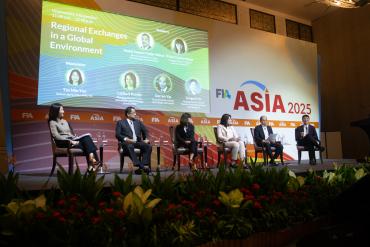
Asian exchanges are expanding their trading hours and operating through severe weather events as part of a broader push to bolster liquidity, regional exchange leaders said on a panel at FIA Asia on 3 December.
A central theme of the discussion was the growing importance of after-hours trading. By overlapping with European and North American sessions, exchanges aim to offer investors more flexibility to hedge positions, respond to overnight developments and access markets when global news breaks. Panellists said these changes are already attracting more liquidity.
Gregory Yu, managing director and head of markets at Hong Kong Exchanges and Clearing, noted that the exchange group’s commitment to uninterrupted trading during extreme weather events has also become an important signal to global participants.
“We are now trading through typhoons, black rain, and yes, it is tough, but at the same time, it eases investors’ minds that the market will constantly operate,” Yu said.
He added that while these efforts support liquidity, the biggest driver of volume growth remains equity market performance across Asia. “We want to make sure that global investors keep their liquidity in Asia.”
Bursa Malaysia introduced night trading sessions for palm oil derivatives four years ago, Mohd. Saleem Kader Bakas, director of derivatives and carbon markets, told the audience. He added that initial resistance from traders – many of whom were concerned about work-life balance – has since faded.
“Now the night trading garners about 15% of our overall trading volume,” he said. “And speaking to the same people who previously opposed it, they say the window now allows much better management of their portfolios.”
Bursa Malaysia extended the trading session for palm oil derivatives to 11.30pm Malaysia time to capture overlap with the Dalian Commodity Exchange, whose night trading sessions finish at 11pm. However, based on market feedback, the exchange plans to shorten the session to end at 11pm.
“The last 30 minutes didn’t really bring in the volumes that would otherwise warrant keeping it open,” Bakas said. “We engage our marketplace, and we listen where we need to listen.”
At Thailand Futures Exchange, the impact of extended hours has varied by asset class, said managing director Rinjai Chakornpipat. Precious metals volumes doubled after TFEX pushed night trading to 3am, and currency futures – including USD, EUR/USD and USD/JPY contracts – rose roughly 25% when hours were extended from midnight to 3am. Equity contracts, however, saw little change.
“It heavily depends on the product,” she said. “When we extended precious metals to 3am, volume doubled… but on the equity side there was no significant change.”
Retail
Panellists also examined whether the sharp increase in retail trading activity across Asia is sustainable – and which emerging segments could drive the next phase of growth.
At TFEX, retail investors account for 40–50% of total volume, with the remainder split between foreign institutions and local market makers. Chakornpipat said the exchange has actively tailored products to retail preferences, introducing smaller-sized contracts to meet demand from younger investors and supporting the development of more professional retail traders.
Bursa Malaysia has spearheaded a similar approach. About 40% of exchange participants are domestic, with 20% classified as retail. To cultivate professional traders, the exchange created the Futures Trading Apprenticeship Programme in 2023, which has attracted more than 5,000 applicants. Six intakes have produced a 35% conversion rate into active traders, helping to ensure liquidity beyond casual retail participants, said Bakas.
Latika Kundu, managing director and CEO of the Metropolitan Stock Exchange of India, noted that retail trading in India has more than doubled over the past decade, driven by economic growth and a shift in mindset towards broader capital markets participation. Exchanges, she said, must remain agile in designing products that meet the evolving demands of a growing retail investor base.
“It’s about how many more products can be offered,” she said. “We have to put on our thinking caps and be agile to what the investor is looking for in terms of different types of products, which are either not as liquid, or they have yet to come into Indian markets.”
Speaking about the Hong Kong market, Yu said that while HKEX attracts primarily institutional investors, there has been growth in the retail segment for micro contracts, weekly stock options and covered call ETFs. He also highlighted the untapped potential of southbound flows from mainland China.
“China has around 200 million retail accounts, of which only a fraction is actively southbound trading, so there is a lot of potential here,” he said.
Darren Yip, group executive, markets and listings at Australia’s ASX, said he sees opportunities in shorter-term products, such as daily options and overnight electricity futures. He also emphasised the importance of investor education, noting that ASX runs an annual options trading game that has grown significantly over the years, providing a safe environment for new traders.
The panellists agreed that sustaining retail growth will require product innovation and ongoing education, with regional exchanges increasingly focused on nurturing long-term, professional retail participation.
