
Global trading in exchange-traded derivatives fell in 2025, largely due to a sharp pullback in equity options trading in India following regulators' moves to curb speculative retail activity.
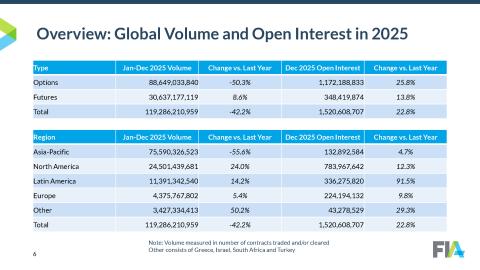
Total exchange-traded derivatives volume fell 42.2% from a year earlier to 119.29 billion contracts, marking one of the steepest annual declines in recent history. Options accounted for the bulk of the drop, sliding 50.3% year-over-year to 88.6 billion contracts, while futures volumes rose 8.6% to 30.6 billion, according to data presented during an FIA webinar this month.
The Asia-Pacific region recorded 75.6 billion contracts in 2025, down 55.6% from the prior year. The contraction was overwhelmingly concentrated in Indian equity index options, which in previous years had fuelled a surge in global derivatives volumes.
For much of the past decade, India’s exchanges have ranked among the fastest-growing derivatives venues worldwide, propelled by a wave of retail participation in short-dated equity options. That boom reversed after the Securities and Exchange Board of India tightened rules last year, raising minimum contract sizes, limiting weekly expiries and collecting options premiums upfront.
“The Indian regulators really cracked down, and we saw a very significant reduction in trading volume,” said Will Acworth, global head of market intelligence at FIA, during the webinar. “Volumes in some contracts have dropped by almost 100%.”
The measures followed concerns that inexperienced retail traders were incurring heavy losses amid intense speculative activity. Even so, Acworth noted that India remains one of the world’s largest equity options markets, even with some of the speculative excess removed.
North America gains share
Even as global volumes fell, open interest – a measure of outstanding positions – told a different story, underscoring continued demand for derivatives as tools for hedging and price discovery. Total open interest in December 2025 rose 22.8% year-over-year to 1.52 billion contracts. Options open interest increased 25.8%, while futures climbed 13.8%.
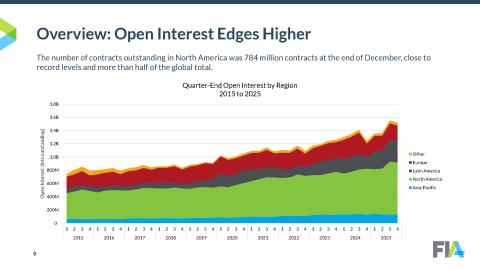
North America dominated that expansion, with the region accounting for 783.97 million contracts in open interest at year-end, up 12.3% from 2024 and representing more than half of the global total.
“Open interest is really dominated by the North American exchanges, which represent a very large amount of institutional trading for price discovery and risk management,” Acworth said.
By contrast, Asia-Pacific open interest grew just 4.7%. Latin America posted the fastest percentage increase, up 91.5% to 336.3 million contracts, albeit from a smaller base.
Low correlations
Beyond regional dynamics, 2025 was marked by unusually low correlations across many asset classes – a backdrop that may help explain why open interest continued to expand even as headline volumes dropped.
Erin Perzov, head of quantitative futures content at Morgan Stanley, joined the webinar as a guest speaker and offered some insights on the dynamics driving trading activity. She said lower cross-asset correlations have allowed investors to increase exposures without proportionately raising portfolio risk.
“One thing that I would highlight that has been supportive of the growth we have seen in open interest across futures and options asset classes is the fact that both within and across different asset classes, the correlation of returns recently has been really quite low relative to what we’ve seen historically,” Perzov said.
She pointed to analysis showing that, outside of areas such as metals and foreign exchange, correlations across futures markets remain well below long-term averages dating back to 2000.
“When you look at the average correlation across all the contracts in a big cross-asset basket, we’re still at really quite low levels,” she said. “That means cross-asset portfolios can tolerate bigger exposures as they are more insulated from moves in any one asset class.”
That environment, she added, “will hopefully continue to be supportive of higher levels of open interest going forward.”
Whether volumes rebound will depend in part on regulatory developments in Asia and the trajectory of retail participation. Open interest, meanwhile, is likely to remain supported by demand for risk management in an increasingly volatile macroeconomic landscape, the speakers agreed.
View the Trends in ETD Trading: Year in Review webinar and related slides here.
