
A skeptical reporter recently asked me about the Commodity Futures Trading Commission’s budget and if it felt justifiable. My hot take: the CFTC budget request feels sensible. And if you know me, you know I am about to bring the data (and charts) to back that up.
Under the leadership of new CFTC Chairman Mike Selig, the CFTC has requested a budget of $410.0 million and 650 full-time equivalents (FTE) for FY2027. This represents an additional 14 employees over last year and an increase of $45 million, or 12.3 percent, above the FY2026 enacted budget.
As someone who oversaw the CFTC when its budget was $97 million with only 437 people in 2007, I am jealous of today’s level of funding. When you add inflation and the growth of markets since my tenure, you might wonder why the agency made such a modest request.
So, let’s dig into the data.
The facts paint a story of the significant growth occurring under the CFTC’s watch in the past few years. It’s easiest to explain with a few graphs taken directly from this year’s CFTC budget.
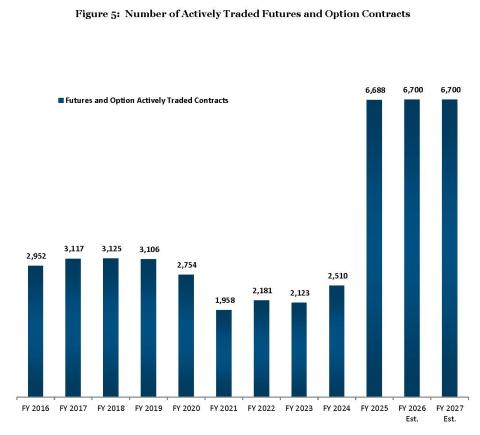
The first demonstrates the growth in the number of actively traded futures and options contracts (see prediction markets and crypto trading). Between 2024 and today, the number of contracts listed for trading has increased 167%.
While exchanges self-certify many of these new contracts for listing, even self-certified products require CFTC staff to analyze whether the products meet the 23 core principles of the Commodity Exchange Act. Listed products also require staff to conduct surveillance of these various products for fraud, manipulation and insider trading. While market surveillance has become more automated, this still takes human oversight to analyze the data and make judgments for regulatory action. These new products and markets will require people - government personnel - to oversee their development.
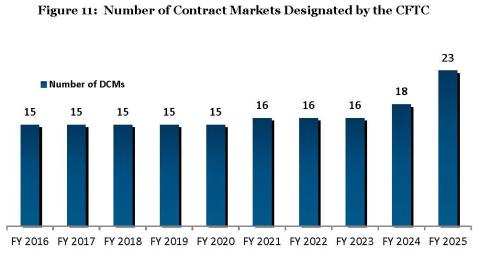
The second graph shows the number of registered exchanges under the CFTC’s jurisdiction. For nearly three decades, the CFTC had overseen a remarkably consistent number of exchanges, ranging between 12 to 18. In FY2025, that number jumped to 23, a 53% increase over two years. And according to the CFTC’s website, the agency has another 13 pending exchange applications filed in the last two years.
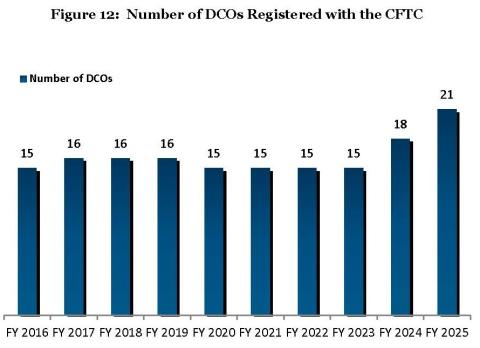
Similar growth is occurring in the number of clearinghouses registered at the CFTC, as new exchanges look for clearing and settlement services. The number of clearinghouses has jumped to 21 in FY 2025, a 40% increase over a two-year span.
The rise of prediction and crypto markets has contributed to this growth in the number of exchanges and clearinghouses. And with Congress actively debating market structure bills for the crypto markets, I would expect even more exchanges to come “on shore” once Congress passes that legislation.
While these new markets have contributed to this growth, traditional markets, like financials, equities and commodities, have continued to experience strong expansion, too.
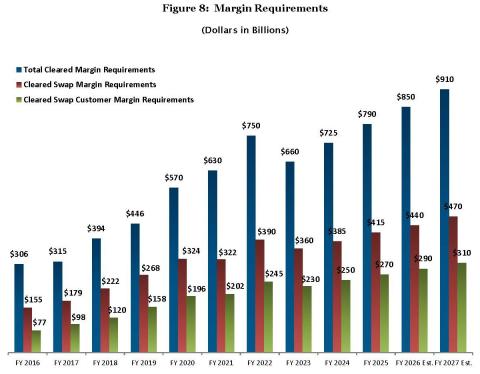
Margin offers one method to quantify this growth. Margin is a proxy for risk under management in our markets, and we have seen a steady increase in customer funds over the last decade. In just the past ten years, the amount of total margin in the system has grown by 177%.
What can we learn?
Clearly, the markets the CFTC oversees are facing significant growth. The CFTC has made a strong case for why more resources are needed, and the facts justify their request. But we must make sure the regulatory structure is modernized to ensure these funding requests are a good use of taxpayer dollars.
For starters, Congress needs to provide greater legal certainty to crypto markets. The markets have asked for, and need, a crypto market structure bill. Then, the CFTC and SEC can implement these new regulations and bring clarity to the industry and to the CFTC’s ability to oversee these growing markets.
Prediction markets also need regulatory guidance, whether by defining insider trading, providing guidance on gaming or giving clarity on the self-certification of new products. I appreciate Chairman Selig’s plans to undertake a rulemaking around prediction markets. Clear regulations incentivize sound markets. I would rather spend taxpayer money on preventing a market disaster than on lawyers cleaning up the mess after the fact.
Traditional markets also deserve attention with this increased budget request. New market structure designs that stack various registration categories need clarity around conflicts of interest. Regulators should scrutinize the move of markets to 24/7. Given the clearing system only works during traditional banking hours, 24/7 trading causes risk to build up overnight or on weekends. This deserves a thoughtful public debate and a pathway to a permanent solution—whether it’s tokenized assets or extended public payment hours.
The list of market improvement projects by the CFTC is endless.
As I said in my remarks at Boca, in my thirty years in this business, this is one of the most exciting times to be in our industry. Just look around at the new energy, the new companies and the fresh ideas.
That success, excitement and growth are contingent on having an adequately funded regulator that can provide strong rules of the road and punish those who break them.
The modest CFTC budget request feels like a small price to pay in paving the path of responsible innovation in our markets.
