As market participants begin to deploy autonomous agents to develop trading strategies and send orders into futures markets, there is a risk that one or more of these agents might act in a way that disrupts the market. In such a scenario, who would be responsible?
Unlike conventional algorithms that execute predefined instructions, AI agents can devise trading strategies in response to goals set by users, raising new questions about accountability when something goes wrong.
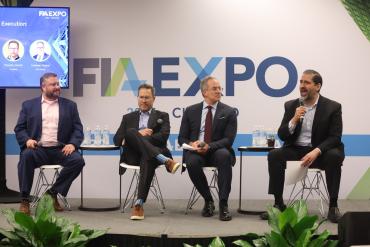
CME Group's chief regulatory officer Andrew Vrabel addressed that question directly during a panel discussion at FIA Expo in Chicago on 4 November. Vrabel, who has worked at CME for more than 18 years, leads a 150-person team of analysts, investigators, data scientists, attorneys and rules experts. Collectively, they are responsible for conducting market surveillance, investigating trade practice abuses, bringing enforcement actions for rule violations and several other functions critical to market integrity.
If an AI-generated order disrupts a market, a market participant cannot simply claim not to know why, Vrabel said. CME's rule on disruptive trading practices does not accept claims of ignorance or lack of knowledge. A participant's inability to explain what an automated system was intended to do could also raise questions about whether appropriate supervisory controls were in place.
The issue is no longer entirely hypothetical. Vrabel said CME had already sent inquiries to participants using large language models to develop trading strategies. The number of inquiries sent to such a participant was "far greater" than for a conventional trader submitting a large market order into a thin book, he said.
When the AI devises the strategy
Renato Mariotti, a partner at Paul Hastings who moderated the discussion, drew on his experience as a former federal prosecutor to explain why agentic AI raises a different accountability question from traditional algorithmic trading.
In a spoofing prosecution, Mariotti said, an algorithm's code helped establish the trader's intent because it recorded instructions that had been given to the programmer. An AI agent can instead be given a goal and devise the strategy used to pursue it. "You cannot put the AI agent on the witness stand," Mariotti said.
He described the potential gap between holding an individual criminally responsible for deliberate conduct and treating the use of an AI agent as a supervisory failure as "accountability arbitrage".
From an exchange's perspective, however, Vrabel said the technology behind an order does not change where responsibility ultimately sits. "It does not matter to me if it is an automated order submitted from an agentic AI trading system or a manual trader," he said.
Every order message, cancellation and modification entering the exchange can be tied back to a human being responsible for monitoring or supervising the activity, he said. CME's rule book also contains a strict-liability provision covering the acts of employees and agents.
Whether that agent is a person or an automated trading system, Vrabel said, "the person that's issuing those instructions is still liable."
Guardrails around AI
For firms developing AI-powered products, much of the focus is therefore on controlling what the technology can do before an order reaches the market.
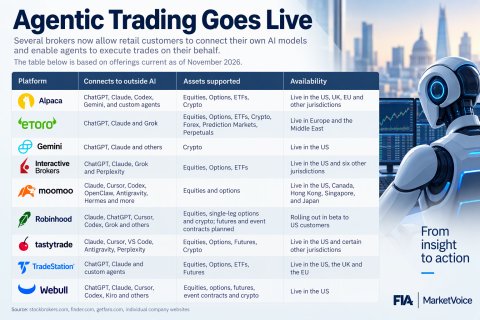
Robinhood is one example of the retail brokers that are making agentic trading a reality [for others, see the chart at the end of this article]. The firm introduced agentic trading in May to a limited number of customers, and by September more than 150,000 users had signed up. Robinhood officials have said the agents operated by those users use Robinhood’s tools almost 30 million times a day.
Robinhood initially allowed retail customers with AI experience to connect their chosen AI through an API. Robinhood subsequently introduced an agentic trading module within the Robinhood app that is designed to remove the need for customers to set up the API connection themselves.
Timothy Cullen, chief compliance officer at Robinhood Derivatives, said that in both cases, the agentic trading happens in a separate, pre-funded account. Customers determine how much money is placed in the account, and the AI cannot independently add or withdraw funds. By default, the customer has to approve trades before the agent sends an order into the market, but customers can turn off that confirmation step.
The AI layer also sits on top of Robinhood's existing trading controls. Asked what would happen if an agent attempted to send a very large market order into a thin market, Cullen said it "does not get that far" because existing order-routing controls would apply. An attempt to buy an extremely large share of daily market volume, for example, could be sent for review or rejected rather than automatically executed.
Timothy Smith, director and head of prime broker and asset management compliance at Coinbase, described a different model. Coinbase Advisor is a non-discretionary, AI-powered advisory platform covering equities, derivatives and crypto. Its large language model can draw on live market pricing, news, customer positions and patterns associated with a user. "What it does not do, at least at this point, is execute trades or act on a discretionary basis," Smith said.
If a Coinbase client subsequently placed an order far larger than the model had recommended, controls at Coinbase Exchange would apply, Smith said. An order could be flagged after the fact for further review and escalation or prevented from reaching the venue in the first place.
Who owns the mistake?
The panel also examined where responsibility lies when something does go wrong. Vrabel compared agentic AI with the execution algorithms brokers have long offered clients, including time-weighted and volume-weighted average price algorithms.
If a firm designs or implements an algorithm incorrectly and it malfunctions despite receiving valid instructions from the customer, that is the firm's problem, he said. If the customer uses the tool incorrectly and causes a market disruption, responsibility may instead lie with the customer.
Agentic systems complicate that distinction because an outcome can depend on the model, the customer's instructions and the controls surrounding it.
Cullen agreed that responsibility exists on both sides. Customers determine their own strategies, he said, but firms offering the technology also need to ensure that their tools and controls work as intended. "Negligence is not an excuse," he said. "You are offering a tool."
The quality of customers' instructions presents another risk. Cullen warned that poorly constructed prompts or ambiguous language can change how an AI model interprets a request.
Vrabel said the potential for a system to misinterpret a customer's instructions made robust controls particularly important. "The guardrails have to be extremely tall," he said.
Smith said Coinbase had also seen customers who demonstrated moderate risk tolerance occasionally submit aggressive orders or orders involving tail-risk or thinly traded assets. The firm responded by giving the model information that allowed it to ask whether an instruction was consistent with the user's previously expressed objectives.
Reconstructing an AI-generated trade
The growth of agentic trading could also change what firms need to retain to demonstrate how a trading decision was reached.
Vrabel said the expectation that firms should be able to trace and reconstruct decisions made by automated trading systems could continue to apply as they adopt agentic technology. In an investigation, this can involve requesting log files, developer notes, source-system information and other data.
With an agentic system, the questions may change, but the principle remains the same: what commands and prompts entered the system, what did it produce and how were those results tested?
Difficulty reconstructing a decision could itself raise further questions, Vrabel said, including whether a participant recklessly disregarded the orderliness of the market or had inadequate supervisory controls.
Smith said Coinbase would expect to show examiners daily reports monitoring model performance and guardrails, quarterly deep-dive testing by an independent third party, and records showing the inputs considered when a recommendation was made.
Cullen said firms may similarly need to demonstrate the entire lifecycle of an agentic trade, from the customer's prompt and the AI's response through to customer approval and the subsequent order.
Vrabel said firms developing agentic trading systems should be able to produce logs containing timestamped commands, prompts and decisions, along with the databases relied upon by the system. Anyone designing such a system, he said, should include the ability "to generate a log every time a trading decision is made."
How high should the guardrails be?
The panel came about a week after the Commodity Futures Trading Commission held a forum on agentic finance, as regulators begin examining how increasingly autonomous AI systems could operate in financial markets.
Vrabel said he was optimistic about the potential for AI to deliver operational efficiencies, but allowing autonomous agents to operate in markets relied upon by pension funds, asset managers and retirement plans raised a different set of concerns.
"The thought of unleashing millions of agents from retail traders that traditionally do not know what they are doing is honestly a little frightening to me. I think that that needs to be a long conversation,” Vrabel said.
AI may change how a trading decision is made. It does not remove the need to establish who is responsible for it.