

The National Futures Association, the self-regulatory organisation for the US futures industry, is reviewing its decades-old rules on promotional material to fit a market where retail traders learn from self-proclaimed experts promoting their trading strategies on social media.
Simply expanding disclosure requirements will not address the problem, according to Dale Spoljaric, vice president, head of member compliance – capital and margin at NFA.
"Believe me, we do not think the answer is, well, just slap more disclosures on it," Spoljaric said at the Futures & Options Expo, held by FIA in Chicago on 3 November.
Old rules, new media
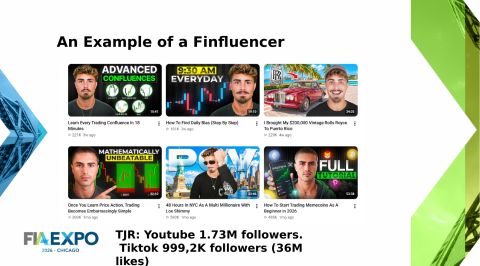
Will Acworth, global head of market intelligence at FIA, started the discussion by highlighting several examples of individual influencers who talk about the success of their trading strategies for futures. In some cases, these "finfluencers" have more than a million followers on YouTube, Instagram and other social media, yet they do not appear to be complying with rules that are designed to prevent misleading promotional material.
He also cited data from a survey conducted by the Financial Industry Regulatory Authority, the self-regulatory organisation for the US securities industry, showing the degree to which younger people rely on social media for guidance on what and how to trade. According to the FINRA survey, 61% of investors under the age of 35 make investment decisions based on finfluencer recommendations, more than double the average across all ages of investors.
FINRA has found that a high percentage of the messaging from finfluencers is misleading. When FINRA conducted a review of social media communications in 2024, it found that 55% failed to disclose that the communication was a paid advertisement, 38% failed to disclose program or product risks, and 30% contained unwarranted, misleading or exaggerated statements and claims.
NFA has had rules on promotional material for decades, Spoljaric said. They are principles-based: no high-pressure sales tactics, no misleading statements and communications that are fair and balanced.
In practice, he said, a member that talks about profit must give equal weight to the risk of loss. One that cites past trading profits must say that past performance does not indicate future results. Hypothetical results need specific disclosure and a comparison with actual trading performance. Member firms must also review and approve material before it is first used.
NFA asks for promotional material during exams, runs its own surveillance, and tests what it finds. "When we find bad acting, we do take cases," Spoljaric said. He cited a 2025 enforcement case over hypothetical results that lacked adequate disclosure, misleading use of historical data and testimonials and "glorified language" that was not balanced by risk.
Most firms are trying to do the right thing, he said. NFA expects firms to fix problems found in exams, but when the same problems recur, enforcement actions become more likely.
Acworth asked if this approach still works in the modern era. He noted that NFA's efforts to apply its rules look like "a drop in the ocean" next to the ever-increasing flood of influencer content, much of it produced with the help of artificial intelligence. "Are you still fighting the last war?" he asked.
Spoljaric said that one of the benefits of principles-based regulation is that it gives both market participants and NFA the flexibility to adjust when the business is done in new ways. He explained that NFA is looking at simpler disclosures, a modern definition of promotional material, and a clearer statement of members' supervisory duties. For example, a live feed on Instagram, he said, "does not fit the mould" of NFA's traditional approach, which requires review and approval before use. He added that NFA is discussing this topic with staff at the Commodity Futures Trading Commission.
Part of the challenge is the recent trend in market structure that is blurring the boundary between exchanges and intermediaries. NFA's rules are designed to apply to intermediaries, such as introducing brokers and futures clearing merchants, that provide customers with access to the futures markets. But in recent years, new exchanges have sprung up that offer futures directly to retail customers. Some of these exchanges have entered into contractual relationships with social media influencers to promote their markets, but they are not covered by NFA's rules on promotional materials.
Broker perspective
Morad Askar, chief executive of EdgeClear, an introducing broker specialising in futures, gave a practitioner's perspective on the issue. EdgeClear ran a programme that reviewed the content of social media creators who mentioned the firm, but after some back and forth with NFA's promotional team, the firm decided that there was not enough clarity to continue the programme.
"It just became grey enough for us to be like, okay, we are going to put that on hold until this is figured out because we do not need this kind of headache," Askar said.
Asked who is to blame when an influencer hired by a firm puts out a bad message, Spoljaric noted that NFA asks its members how they contract with and get comfortable with such marketers, but it has not drawn a bright line on specific responsibilities beyond the member's general duty to supervise its operations.
Under US law, all firms and individuals engaging in regulated derivatives activities must register with the CFTC and hold active membership in NFA. NFA's membership currently consists of more than 2700 entities and more than 37,000 "associated persons," the term it uses for individuals who solicit orders, customers, or customer funds on behalf of a registered firm such as a futures commission merchant or a commodity trading advisor.
Askar was more direct. In his experience, he said, "the member is always responsible." Firms cannot stop people from saying things, he added, but they can show that they supervised, removed problematic content, and documented the review process.
Agnese Rozite, a former prediction market trader, shared some insights from her experience as a finfluencer. She made educational videos for Kalshi, the leading prediction market, for about three months. In regulated advertising, a script is checked before filming and edited afterwards, she said. In prediction markets, however, "nobody is really doing that in this space yet."
She also pointed to what she saw as a double standard. Commentators on CNBC and Bloomberg give views on stocks without disclosing their profit and loss, she said, while prediction market influencers are asked to prove their track record of success in trading.
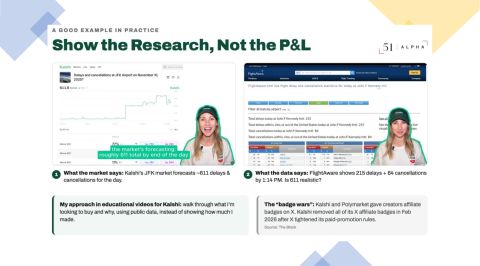
Rozite gave the example of a prediction market on flight delays during the US government shutdown. Because the market used FlightAware as its resolution source, she said she could monitor the number of delayed flights as the data was updated and use the pace of delays to estimate whether the total was likely to reach a particular threshold. She used the example in her videos to show how she researched a trade and how the same approach could be applied to other markets.
Rozite, who now works as an independent event organiser, warned that more regulation may be coming via lawsuits. She cited a recent action by the New York attorney general, who is seeking information on Kalshi's marketing and advertising practices as part of a lawsuit against the company.
Asked from the floor why financial products should be treated differently from consumer brands, Spoljaric said that rules against misleading marketing exist for food and other products too. Rozite pointed to leverage as a key difference, noting that options, prediction market contracts and perpetual futures let traders take positions of 5x or even 10x. Askar agreed, saying that the risk of loss is much lower with consumer products. "You can't lose your house buying a lot of Tide," he said.
Lifestyle over education
Askar, who posted videos about his own trading ideas for 12 years before starting EdgeClear, said the nature of trading-related social media content changed during the Covid-era boom in trading from home. "It became about lifestyle, it was no longer about trading, and that is what attracted audiences," he said. Influencers with expensive watches and private jets drew hundreds of thousands of subscribers, he added, and some deleted videos of losing trades or showed only the winning account.
From the brokerage and clearing side, he said, the picture is different. "It is most likely that the person you're following isn't making money," Askar said, adding that influencers are not required to disclose anything.
Rozite said finfluencers earn more when posts go viral. "So they are incentivised to go viral even if they are saying things that are not true," she said. In her own videos, she explained her research and limited the size of the trades she discussed to 25 contracts at most, so as not to encourage beginners to stake large sums.
Both Rozite and Askar called for better education. Beginners often ask her where to start, Rozite said. "I think there is a massive gap that needs to be filled." At the same time, influencers need some creative freedom, along with clearer rules on what they can and cannot say, she said. "So, I think just having a little bit more guidelines would be great. And hopefully that happens soon."
