
Tokenisation that relies on blockchain technology will continue to transform Wall Street in the second half of the year, according to executives at global banks, buyside firms and infrastructure providers.
Despite persistent criticism of cryptocurrencies and the underlying technology that make them possible, transforming real-world assets like bonds, commodities and currencies into their digital equivalents that transact on blockchain rails is far past the conceptual stage and happens on a daily basis, the executives said during a 10 March panel discussion at the annual FIA Global Cleared Markets Conference in Boca Raton, Florida.
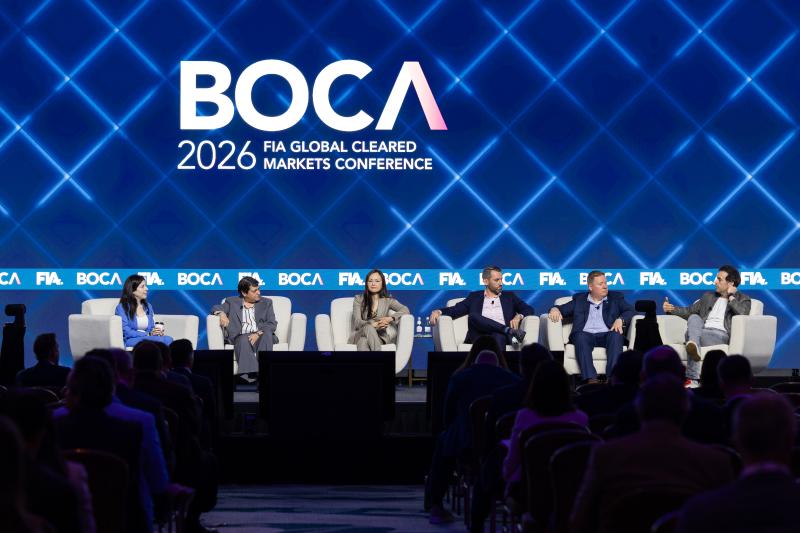
“It’s important for everyone to know a lot of these use cases are live and very robust,” said Mike Reed, senior vice president and head of digital asset partnership development at Franklin Templeton Investments. He mentioned his firm’s tokenised version of a money-market fund as an example. “It’s not something exotic or crazy, it’s the most boring thing in the world, just offered in tokenised form.”
Tokenised assets represent a broad shift in how Wall Street deals with payments, collateral management, lending and risk management. Blockchain-based transactions allow for near instantaneous settlement confirmation, a huge change from how banks typically reconcile trades and collateral within siloed segments of the firm. Mistakes are costly and common – a recent Nasdaq study on tokenised collateral found that financial firms “expect blockchain collateral solutions to help avoid approximately 1 in 8 failed trades.”
Last year saw a pronounced acceptance by many financial firms that tokenisation has staying power. Total tokenised assets jumped four-fold to $26.4 billion as of 9 March 2026, compared with $6.6 billion a year ago, according to research site RWA.xyz. The largest chunk of those assets come in the form of tokenised US Treasury bonds, with $10.9 billion as of early March. Commodities came in second, with $5.8 billion. On the fixed-income side, BlackRock's tokenised BUIDL fund, launched in 2024, invests only in cash, US Treasuries and repurchase agreements, and pays interest while holding tokens on the blockchain.
Similar to tokenised assets in general, BUIDL grew about 3.4 times in the past year, to $2.23 billion in assets under management as of early March from $668 million a year ago, according to RWA.xyz.
A growing number of banks and institutional investors now see the technology as a viable way to update what, in many cases, is decades-old infrastructure that comprises the financial system, said Artem Korenyuk, a managing director in digital assets for Citigroup.
“The broader thesis is the notion of blockchain and tokenisation serving as a general purpose technology to rewrite and re-platform the general infrastructure” of financial markets, Korenyuk said. “You get the potential to allow blockchain tokenisation to do to financial markets what the iPhone did to the phone, to the Internet browser, to the pocket calculator.”
Regulatory complexity presents a major hurdle to broader tokenised asset adoption. Assets on a blockchain are globally available and do not adhere to jurisdictional boundaries. In just one example, the SEC will face challenges as it tries to regulate tokenised US equities that trade 24/7 with worldwide accessibility. Compounding that, how do regulators in Europe, Asia and the US align their approach?
“While jurisdictions such as the US, Singapore, the UAE and Hong Kong have made meaningful advances, regulatory approaches are still uneven,” Investa, a Singapore-based tokenisation platform, said in a recent report. “Global consistency has yet to emerge. For institutions operating across borders, this fragmentation introduces cost and uncertainty.”
Panellists at the FIA conference cited interoperability between different blockchain networks, integration with legacy systems and scalability as major challenges to tokenisation.
“One of the hardest things DTCC is doing today is [figuring out] how you integrate into legacy [systems] and also come with an operating model that gives your members a user experience that’s not going to break the bank,” said Yuval Rooz, co-founder and chief executive officer of Digital Asset.
Sarah Hammer. head of trading for digital assets and artificial intelligence compliance at Charles Schwab Corp., offered ways to reduce risk with tokenised assets, saying, “What’s exciting me about tokenisation is the opportunity to look at the risk in the system as a whole – reducing counterparty risk, as an example, reducing time to settlement and making more efficient use of the collateral we have.”
As the Nasdaq study demonstrates, many agree with her thoughts. It found that “the average firm manages approximately $74 billion in total collateral across all activities, often through siloed and legacy-constrained collateral management systems that dampen mobility and utilisation. Settlement matching and delivery issues further plague 70% of respondents daily, creating an ‘operational tax’ that more than doubles the cost of holding and moving collateral through traditional collateral management processes.”
In December, the US Securities and Exchange Commission allowed DTCC to proceed with its tokenisation project for some of the securities it holds, a partnership with Digital Asset and the Canton blockchain. As of early March, Canton processed about $350 to $400 billion in US daily repo transactions. The overall US repo market has about $12.6 trillion in daily transactions, giving Canton an approximate 3% share.
“Traditionally, repo was an overnight market, so you lock your collateral overnight and that’s it,” Rooz said. Digital Asset is working with Broadridge Financial Solutions on the tokenised repo trades, which now average 20 minutes on the Distributed Ledger Repo platform, Rooz said. That means hedge funds and proprietary traders can now recycle the same amount of collateral for more business, creating efficiency in the markets.
“With the same balance sheet, I can now do 50 percent more business,” he said.
The time of proof-of-concepts for tokenised assets is over, according to Nadine Chakar, managing director and global head of DTCC Digital Assets.
“The argument over the technology is over. We know the technology works,” she said. "US markets will start the tokenisation process by the middle of this year,” Chakar said.
Rooz agreed. “Next year we will be talking about volumes of tokenised products, rather than talking about what we are going to tokenise,” he said.
