
Disruption to Gulf shipping is likely to have a lasting impact on global energy markets, even if traffic through the Strait of Hormuz begins to normalise, commodity market experts warned at FIA’s International Derivatives Expo in London.
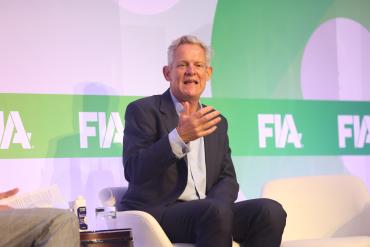
Spencer Dale, Professor in Practice at the London School of Economics and former chief economist at BP, said the market could take years to rebuild lost oil stocks. “At 2 million barrels a day, it would take over two years to rebuild the amount of lost oil,” he said.
The timeline for a return to normal conditions remains uncertain. “We don’t know what the production start-up looks like,” said Saad Rahim, chief economist at Trafigura, speaking on an IDX panel on the impact of Middle East conflict on global commodities.
How quickly the Persian Gulf oil market recovers will depend on two key factors: when oil producers restart output and when tanker operators are confident enough to resume shipping.
Producers and shippers are unlikely to move quickly until they are convinced that the memorandum of understanding reached on 17 June by Iran and the US will lead to a durable peace. Restarting production is not straightforward, Dale noted. If wells are shut down again after reopening, pressure can be lost and water can enter the system, potentially compromising the asset.
“If you’re not confident the agreement is going to hold, you’re not going to start opening up wells only to shut them again,” he said. The same caution applies to shipping. “I’m not going to move vessels into the strait if there’s a risk they could be stranded for months.”
Price risks remain
Commodities traders have their own difficult calculations to make. While some analysts had forecast sharp price hikes earlier this year, these have yet to materialise, in large part because countries have drawn on their petroleum reserves and inventories, Dale said.
However, the risk of volatility remains. Oil prices tend to be relatively inelastic, and as petroleum markets struggle to rebalance supply and demand, an unexpected shortage could still trigger a sudden spike.
Dale expects this volatility to persist beyond the immediate disruption. “My hunch is we’re moving into a world where the structural volatility of fossil fuel prices is going to increase,” he said, citing geopolitical fragmentation, the intermittency of renewable energy sources and uncertainty over the pace of the energy transition.
The disruption is also likely to have longer-term implications for energy investment. Net importing countries may accelerate the build-out of renewable capacity, while exporters could expand fossil fuel production as a hedge against geopolitical risks.

At the same time, market participants are developing new tools to manage price risk in renewable power. In Europe, shorter-term trading and the growth of 24/7 intraday power markets have increased the number of contracts traded, said Tobias Paulun, chief executive of European Commodity Clearing.
Will Acworth, global head of market intelligence at FIA, noted that futures based on hourly electricity prices are now available in Texas, one of the fastest-growing renewable energy markets in the US.
Trading activity surges
Despite the uncertainty, recent disruption has supported trading activity across commodity markets.
“We saw record trading volumes across all commodity exchanges in March, so it’s certainly been good for brokers and exchanges,” said Cheryl Backhouse, chief operating officer of the metals division at Marex.
Activity has been broad-based. “When you look at the events of the last four months…we saw record levels of activity in every single client segment,” said Derek Sammann, the global head of commodities markets at CME Group.
The effects of the disruption have extended well beyond oil, panellists agreed. Chris Edmonds, president of fixed income and data services at ICE, pointed to knock-on effects in consumer markets, noting that shifts in the relative pricing of synthetic and natural materials could even influence product mix in retail goods.
“Pay attention to the amount of clothes being shown to you that are cotton-based versus polyester-based,” he said. The cotton may be showing up now because of shortages in refined petroleum products, he said, but this could change if fertilizer shortages make cotton more expensive.
Metals markets have also been affected by the closure of the strait. The Gulf accounts for 6-10% of global aluminium production, but because 80-85% is exported, supply disruptions have had an outsized impact, said Georgina Hallett, chief sustainability officer and head of physical markets at the London Metal Exchange.
“In the EU, around 20% of supply comes from the Gulf, so disruption there has a significant impact,” she said. The LME recently experienced a 66-day backwardation in aluminium, one of the longest on record.
Supply flows have shifted sharply. In May, there were no deliveries of aluminium into LME warehouses, compared with a typical monthly average of around 50,000 tonnes, Hallett added.
More broadly, the disruption has compounded other pressures on commodity markets, including the impact of the Trump Administration’s tariffs against dozens of countries introduced last year. “Markets were already under stress, and this created a double or even triple whammy effect,” Sammann said.
