
Hong Kong has seen its role as a gateway between China and global markets strengthen amid a surge in cross-border trading and derivatives activity. Market participants say sustaining that momentum will depend on continued investment in infrastructure and market diversification.
Speaking at FIA Forum Hong Kong on 23 April, industry leaders pointed to strong growth across asset classes and deepening connectivity with mainland China as key drivers of the city’s next phase of growth as an international financial centre.
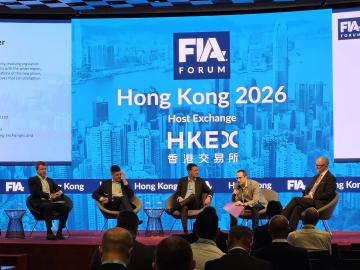
Setting the scene, Clement Cordier, head of derivatives clearing services for Asia at HSBC, highlighted the pace of expansion. “Derivatives volume in Hong Kong has been strong and continues to grow,” he said, pointing to rising activity in index products and single stock options.
Cross-border equity flows have also accelerated. Northbound Stock Connect trading into China rose 42% year-on-year in 2025, while Southbound flows have grown even faster, Cordier said. Northbound Bond Connect activity has also increased significantly, with trading volume surpassing RMB 1 trillion for the first time in March.
“Here you have multiple assets, cross-border activity and derivatives activity all growing in Hong Kong,” Cordier said, adding that the city is on track to become the world’s largest wealth hub by 2030, a shift likely to drive further demand for multi-asset investment and risk management.
At the centre of this growth are Hong Kong’s cross-border “Connect” programmes linking financial markets with mainland China.
“Stock Connect is the primary mechanism for international investors to access China A-shares,” said Brian Roberts, head of equities product development at Hong Kong Exchanges and Clearing. “Around 70% of foreign exposure to that market comes through Stock Connect.”
Southbound flows into Hong Kong now regularly exceed HKD 100 billion a day, while Bond Connect continues to strengthen links between Hong Kong and mainland fixed income markets.
“This is where the world comes to risk-manage China exposure,” Roberts said, noting that strong IPO activity continues to support the expansion of the derivatives ecosystem through new listings and associated products.
Chris Bainbridge, co-head of prime services and clearing, Asia-Pacific, SG Securities (HK) Ltd, described the city as a “risk hub” supported by a full spectrum of products.
“Equities anchor the whole base, ETFs [exchange-traded funds] concentrate the risk, futures are used for hedging and managing beta exposure, and options support event-driven and volatility strategies,” Bainbridge said. Combined with liquidity, market structure and price transparency, this creates an environment capable of attracting a wide range of global investors.
Trajectory
Panellists emphasised that Hong Kong’s trajectory is closely tied to developments in China. “You can’t look at Hong Kong in isolation from China, and you can’t look at China in isolation from Hong Kong,” said Russell Beattie, managing director, Asia Pacific, CME Group. “We made some strategic bets about two years ago. We extended our lease, hired more people, and built out Hong Kong into our second-largest Asia-Pacific hub.”
He pointed to rising cross-border capital flows and increasing international expansion by leading Chinese futures firms, many of which are using Hong Kong as a base to access global markets. “The capital flows we’re seeing across the border and into global markets are starting to increase significantly,” Beattie said.
The broader regional shift is also notable, he added. In the third quarter of last year, 63% of global trading volume took place on Asia-Pacific exchanges, underscoring the region’s growing importance.
Hong Kong also continues to benefit from its role as both a product and regulatory bridge, added Martin Graham, APAC head of government and regulatory policy, Citadel Securities.
“People can set up in Hong Kong, trade in a familiar way and access markets that might otherwise be harder to navigate,” Graham said. “That regulatory interface is a key advantage.”
Look to the future
Looking ahead, panellists agreed that maintaining this position will require continued focus on infrastructure, regulation and diversification.
HKEX’s Roberts pointed to opportunities beyond equities, particularly in fixed income and commodities. As the world’s largest offshore renminbi centre, Hong Kong already has a strong foundation for fixed income growth, while commodities represent a key area for further development.
“I think we’ll see Hong Kong diversify from being primarily an equity centre into a broader international financial hub,” Roberts said.
Infrastructure improvements will also be critical. SG Securities’ Bainbridge highlighted the importance of clearing efficiency, cross-margining, collateral mobility and real-time risk management in supporting future growth.
“It’s about investing in the infrastructure that will define competitiveness going forward,” he said.
Taken together, the discussion highlighted a market at a pivotal moment with strong growth, increasing global relevance and deepening integration with China. As panellists emphasised, its next phase will depend on how effectively it builds on those foundations.
