
FIA’s annual Boca Conference, which we hosted last week, has been referred to as the Davos of Derivatives. And based on the buzz of last week, Boca51 certainly delivered.
But Boca also has an unlucky reputation of coinciding with some notorious market events, including the Russia Invasion of Ukraine (2022), Silicon Valley Bank (2023), the beginnings of Covid (2020) and now the US bombing of Iran (2026). These past crises have forced attendees out of the sunshine and into their hotel rooms to deal with the Boca “crisis du jour.”
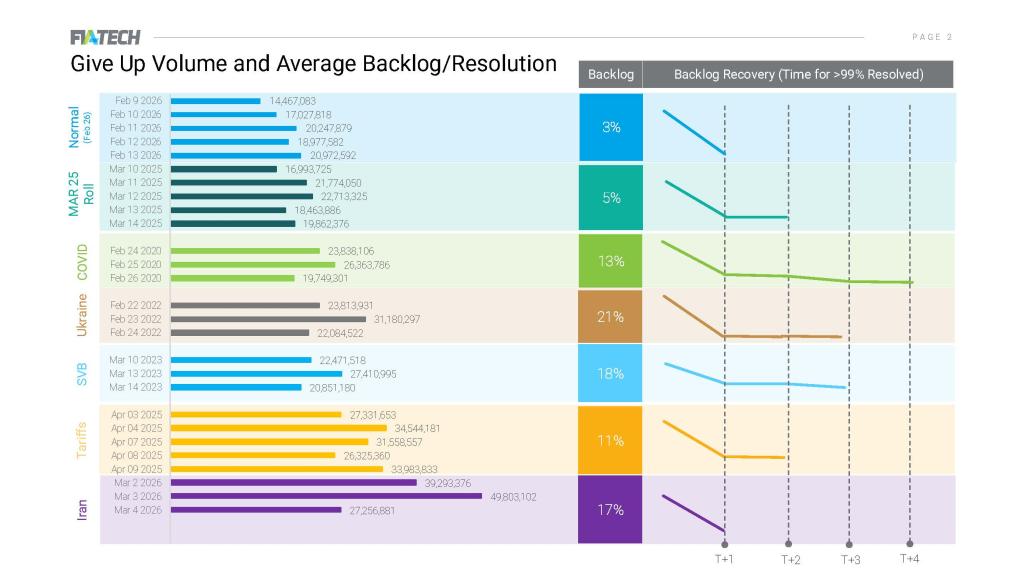
Not this year! Yes, we did have record volumes in the lead up to Boca after the Iran bombings began. March 3rd of this year saw the highest volumes of any day on record, according to data gathered by FIA Tech. But the markets seemed to digest these volumes with a yawn compared to past peak days.
How did our industry process nearly double the volumes of past crises as if it were a normal trading day?
The answer: technology, standards and metrics.
When covid shut down the world’s economy in 2020, our markets strained from the high volumes and backlogs. It took nearly a week to clean up these misallocated trades, adding significant operational and market risk to a stressed financial system. The warning lights of enterprise risk departments blinked red for many in our industry.
This served as a sober wake-up call for the industry.
Clearing firms, whose back-office systems were overwhelmed by these volume spikes, began to invest in additional capacity and improved technology that could withstand these heightened volumes. Firms implemented dynamic controls that guarantee continuous capacity cushions as new high-water marks are reached.
The industry also rolled up its sleeves to form the Derivatives Markets Institute for Standards (DMIST) and began by developing a standardized timeframe for allocating trades—the so-called 30-30-30 standard. This ensures clients, executing brokers and clearing brokers all perform their respective duties within 30 minutes on execution date to confirm that trades get to the right place at the right time.
With these investments and standards in place, the behavior of the market started to change. Market infrastructure and brokers educated customers on the 30-30-30 standard. Technology vendors built solutions to monitor and meet the standard. And we began to collect metrics to measure our progress.
Fast forward to today, the volumes experienced during the Iran incursion were extraordinary. More than double typical trading days. And yet, settlement times during these high-water marks were the same as normal trading days. Based on give-up volume data captured by FIA Tech, the progress became clear:
The timeline for resolving delayed trades during the Iran incursion was routine with 99% of backlogged trades being allocated to the right account within 24 hours.
These volumes were 88% higher than Covid volumes, yet the timeframe for settling delayed trades decreased by 75%.
The record Covid volumes experienced in 2020 that significantly stressed our markets are not even in the top 100 trading days since that time, showing the capacity controls and technology investments are paying off.
This represents notable progress in making our front-to-back operational workflows more efficient and our markets safer. We have made good progress, but there remains more to do. And it seems that the Boca curse has been exorcised for now.
In today’s world, normal is not newsworthy. But when it comes to market safety and resilience, sometimes the mundane is worth crowing about!
