
The US futures and options markets are the deepest and most liquid in the world, but they are also highly concentrated, and that is one reason why Man Group, one of the world's largest alternative investment firms, does more of its derivatives trading in Europe than the US.
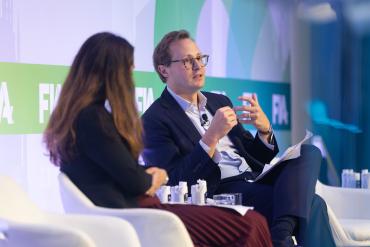
Speaking at an industry conference in London, Antoine Forterre, the company's chief financial officer and chief operating officer, revealed that in 2025, Man Group traded nearly $4 trillion in notional value of exchange-traded derivatives. Of that amount, 45% was in European markets, 39% was in the US, and the remaining 16% in Asia.
Forterre commented that the US markets are the most liquid "by far" but cautioned that the they have become more vulnerable to a "regime change" because of certain changes in recent years.
For example, he noted that volatility dispersion, a term meaning the gap between the volatility of an index and the volatility of its components, has reached an unusually high level, mainly because of the outperformance of a small number of technology and AI companies. He also noted the growing popularity of short duration options and commented that 60% of the notional value of S&P 500 index options trading comes from positions with zero days to expiration.
"The nature of markets and the nature of volatility has changed," Forterre told an audience of brokers and exchanges at the FIA International Derivatives Expo on 17 June. "It's not higher, it's not elevated. It's different. It's more concentrated, more reflexive. It makes regime changes more likely, more brittle and less obvious when they come."
The term regime change is used by fund managers to describe changes in how financial markets behave, typically in response to structural changes in macroeconomics, geopolitics, monetary policy and other fundamental factors. For firms like Man Group, anticipating regime changes is critical to avoiding losses and adjusting investment strategies.
Forterre acknowledged that Europe is more fragmented than the US, but he portrayed that in a positive light. While the US has a centralized market infrastructure and regulatory framework, the European derivatives market is fragmented among multiple exchanges in multiple jurisdictions. Although that makes trading more expensive, Forterre said the benefit is that the region offers more diversification of investment opportunities.
"Europe is more fragmented, but with fragmentation comes diversification," he said. "We are here to provide alpha, so diversification is an important aspect of what we deliver."
Forterre did not indicate which markets Man Group uses in Europe, but one of the bright spots is the rapid growth of volume in futures and options based on short-term interest rates such as Euribor, Sonia and ESTR. The so-called STIRS markets are among the largest exchange-traded derivatives markets in the world and one of the most effective ways to implement investment strategies related to movements in monetary policy and economic growth.
According to ICE Futures Europe, the London-based exchange that has the majority of trading volume in European STIRS, this market is now larger than its US counterpart. For example, on 12 June, ICE reported open interest of 63 million futures and options based on the three-month versions of Euribor, Sonia and ESTR. That same day, CME Group, which is the home for the primary STIRS market in the US, reported 56 million contracts of open interest in its three-month SOFR futures and options.
The other leg of Man Group's diversification strategy is Asia, and Forterre said the company's trading activity in this region is growing rapidly. He singled out three countries in particular – China, India and Korea – and said the futures and options markets in these countries are growing in liquidity and depth. He also noted that China's equity and bond markets are among the largest in the world, and China's commodity futures markets offer niche markets that cannot be found anywhere else in the world, such as futures on plastics and eggs. That provides some unique investment opportunities, and both the firm and its clients see those opportunities as a "source of alpha diversification," he said.
China's commodity futures markets are among the largest in the world, with only the US futures markets matching them in terms of volume and value. Access for overseas investors is complicated, but Man Group is one of several global investment managers that have established offices in China and have added Chinese futures to their investment portfolios. Man AHL, part of the quantitative investment arm of the group, has been trading Chinese markets onshore since 2014 and received a "qualified foreign institutional investor" license from the Chinese regulators in 2020.
