
At FIA’s International Derivatives Expo in London, policymakers and market leaders delivered a clear message: Europe has the scale, capital and talent to compete globally – but turning that potential into growth will require faster execution, deeper market integration and more decisive action.
Across a keynote policy update and a mainstage panel, speakers pointed to a familiar set of barriers: fragmented markets, constrained bank balance sheets, underused household savings and uneven national implementation of rules. The challenge, they said, is no longer identifying the problems, but delivering solutions at pace.
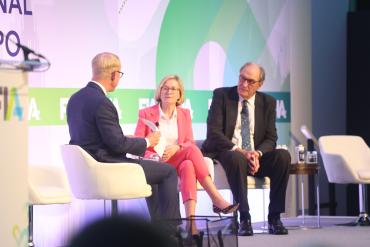
In the opening keynote discussion, Mairéad McGuinness – who served as European Commissioner for financial services from 2020 to 2024 – described a Europe adapting to a harsher global environment and navigating what she called “a more hostile world”.
McGuinness said the European Commission has been talking about the need to improve competitiveness for some time, but what has changed is the sense of urgency.
“Really, it is up to the political leadership of Europe in the member states to actually deliver now on what they said they are committed to. We're going to have to move from words to much more targeted and swift action. We don't have the luxury of time.”
David Wright, chairman of European think tank Eurofi, was more direct about the scale of the challenge. Europe, he said, is operating in a far more pressured geopolitical and economic environment, caught between an aggressive Russia, a changed relationship with the US and persistent trade imbalances with China.
Despite its stability and strong foundations, the region risks falling behind unless it moves beyond incremental reform and builds genuinely dynamic capital markets.
“We’ve got to go much further,” he said. “We need the markets to be bold.”
Wright pointed to Europe’s long-standing weakness in scaling companies, with many firms ultimately turning to US markets to raise the capital for growth. More flexible competition policy and clearer political backing, he said, will be essential to changing that trajectory.
With EU leaders now pushing market integration and digital initiatives, there are early signs of momentum. But the real test will be delivery. “Now is the time for action,” he said. “If we look at the dynamism of US capital markets, frankly, we’ve got to emulate some of it.”
Regulation

That theme carried into the following panel, moderated by former MEP Kay Swinburne. She acknowledged the structural complexity at the heart of European policymaking. With 27 member states, “it’s always a challenge to get things to work – and even more of a challenge is how those 27 countries implement those changes”.
While regulation dominated much of the discussion, panellists were clear that it is not the only factor.
“Regulation is not going to make us competitive,” said Corentine Poilvet‑Clédière, CEO of European clearinghouse LCH SA. “What [clients] are buying is liquidity, efficiency and certainty.”
The US, she argued, does not dominate because it has fewer rules, but because of the concentration of capital, talent, liquidity and decision-making within a single market. For Europe, the priority is therefore not simply more regulatory adjustment, but a much stronger commitment to using its own scale more effectively.
For Poilvet‑Clédière, accommodating national practices is “a straight competitive discount”, one that fragments liquidity, adds complexity and weakens Europe’s ability to compete. Incremental tweaks may help at the margins, she suggested, but they will not address the underlying issue.
The real question, she said, is whether Europe is “bold enough” to move beyond preserving existing structures and instead build the financial market infrastructures needed for the next decade. Europe has the scale, she added, but “we have to start really seriously acting like it”.
Chris Rhodes, president of ICE Futures Europe, echoed that view, arguing that a shift in regulatory mindset is needed.
“We’re not going to win new business through prescriptive regulation,” he said, calling instead for a more principles-based and proportionate approach. “We need more focus on the reward of acting and the risk of not acting.”
Capital constraints
From a banking perspective, the competitive imbalance is becoming more pronounced. Gaspard Bonin, deputy global head of derivatives execution and clearing at BNP Paribas, pointed to a sharp shift in market share, with US banks gaining share in European investment banking and markets businesses while European banks have lost ground over the past decade. He noted that while some institutions have been able to maintain or grow their position, the broader trend has been one of decline for European banks.
“There is clearly something to be done on the capital constraints on European banks,” he said, linking the trend to regulatory and balance sheet pressures.
The issue reflects a deeper structural divide. Europe remains more reliant on bank financing, while the US benefits from deeper, more integrated capital markets that support scale, liquidity and capital efficiency.
Robbert Booij, CEO of Eurex, the largest derivatives exchange in Europe, said those pressures are becoming more visible as European fixed income and derivatives markets expand. Increased issuance by European governments and the European Commission is feeding through into repo, listed derivatives and swaps markets, all of which require balance sheet capacity.
“Clients constantly tell us: help us deal with these capital constraints,” he said.
For Eurex, that means expanding tools such as cross-product margining and offsets to help participants manage larger volumes more efficiently. Booij also pointed to uneven market access rules across Europe, which can make it harder for some firms, including market makers, to compete on equal terms.
Fragmentation
For market infrastructures, fragmentation is not an abstract issue – it is embedded in how Europe’s markets are supervised and operated.
Simon Gallagher, CEO of the London arm of Euronext, said the exchange group operates across eight markets that remain national in structure. While Euronext has integrated them commercially and technologically, supervision is still handled at national level, adding complexity as the group expands.
The solution, Gallagher argued, lies in greater centralisation and a more unified approach to supervision. Euronext has shifted its position in favour of single supervision by the European Securities and Markets Authority, an issue that remains politically sensitive across the bloc.
“If we don’t get there, we’re going to be in bad shape in Europe,” he warned.
For Gallagher, this is not simply about regulatory efficiency. A more centralised supervisory framework could support greater operational efficiency for pan-European market infrastructures and help create a clearer vision for Europe’s financial system.
He also pointed to the complexity of Europe’s post-trade landscape, particularly for international firms navigating multiple systems and infrastructures. That fragmentation increases costs and makes it harder for Europe to compete at global scale.
Progress
Across both sessions, the message was clear: Europe’s challenge is not identifying the issues but acting on them. Competitiveness will depend on building scale, integrating markets and mobilising capital, not refining rulebooks in isolation.
Fragmentation, underused capital and regulatory complexity remain persistent barriers. Europe has the capital and infrastructure to overcome them. The question now is whether it can turn that potential into progress.
Listen to a recording of Walt Lukken's conversation with Mairéad McGuinness and David Wright here.
