
For decades, expanding trade, integrated supply chains and global pricing benchmarks brought commodity markets closer together. Now conflict, tariffs and resource nationalism are pushing them apart.
Since the pandemic, repeated disruptions have redirected physical inventories and sharpened regional differences in markets including natural gas and copper.
“We have seen, whether it’s the pandemic, tariff wars or the Russian invasion of Ukraine, a deglobalisation, if you like, and much more regionalisation of prices,” said Guy Wolf, global head of market analytics at Marex, during an FIA webinar on exchange-traded derivatives activity in H1 2026.
The regional shift is unfolding amid a sharp increase in listed commodity derivatives activity. Trading in metals futures and options rose 63.2% year-on-year to 2.64 billion contracts in the first half of 2026, according to FIA data presented during the webinar. Energy volume increased 34.1% to 2.08 billion contracts.
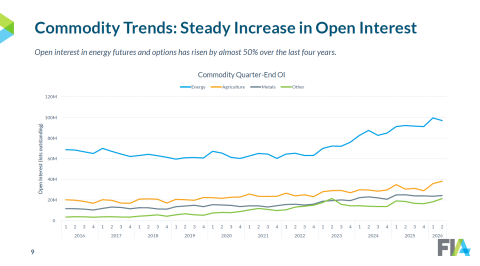
Although energy trading fell back in the second quarter, it remained well above previous levels, said Will Acworth, FIA’s global head of market intelligence. Open interest also indicates that the expansion has gone beyond a temporary burst of trading.
“To see that open interest in energy futures and options is up by almost 50% over the last four years tells you that these markets have really attracted a tremendous amount of flow,” Acworth said.
The increase in activity comes as companies face more region-specific risks. Sanctions, tariffs and supply disruptions can affect the price of the same commodity differently across regions, increasing demand for contracts that more closely reflect local market conditions.
Acworth said that distinct markets need not produce a single winner, however. Copper, for example, has significant pools of liquidity in London, New York and Shanghai, although London remains the largest after volumes and open interest are adjusted for contract size. Contracts reflecting different prices and physical exposures can grow alongside one another, he said, creating additional opportunities for hedging and arbitrage.
“When you have more liquidity in the market, and each one is measuring a slightly different thing, you end up with opportunities for more arbitrage, slightly different hedges and slightly different trading strategies,” Acworth said. “That leads to a larger market overall.”
A benchmark shaped by disruption
European natural gas provides one of the clearest examples of greater regionalisation. Europe’s move away from Russian pipeline gas has made Dutch TTF (Title Transfer Facility) increasingly important, not only as a benchmark for European supply but also as a price signal for liquefied natural gas cargoes moving around the world.
Acworth described TTF as “probably the second most important benchmark for gas trading” after the Henry Hub benchmark in the US gas market, and a key instrument for assessing the effect of disruption in the global LNG market.
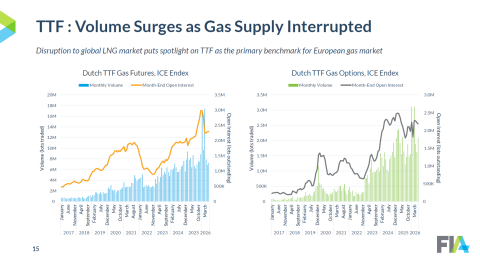
Trading in ICE Endex’s TTF gas futures reached 65.7 million contracts in the first six months of 2026, up 35.9% from a year earlier. Open interest at the end of June stood at 2.3 million contracts, up 10%. TTF's growth also reflects a shift in how the market operates.
“This used to be a market dominated by swaps rather than futures,” Wolf said. As liquidity developed in the listed market and European gas became more exposed to geopolitical disruption, the contract began attracting funds seeking sufficiently liquid markets with different exposures from other commodities. “This market is here to stay,” he added.
Copper heads west
Copper shows how the prospect of a tariff can alter physical flows even before a policy takes effect.
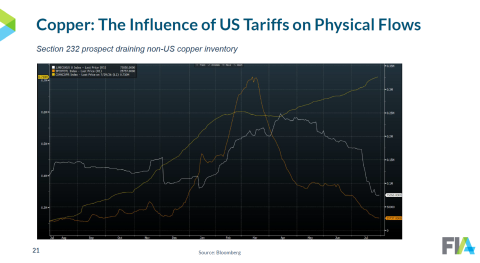
Although no tariff on refined copper was imposed in the first half of the year, repeated suggestions that one might be introduced created a premium in the US market, according to Wolf. That gave traders an incentive to move physical copper towards the US from other parts of the world.
“Essentially, the US domestic price is the best price in the world,” Wolf said. “There’s an incentive to take copper from the rest of the world and ship it to the US before a tariff comes in.”
Those regional differences became particularly visible in warehouse inventories. The webinar presentation showed falling London Metal Exchange stocks outside the US and declining inventories on the Shanghai Futures Exchange, while CME Group’s COMEX stocks moved in the opposite direction.
For Wolf, the change was “probably the most visible, clearest example of the resource nationalism and strategic stockpiling that’s going on in the world right now”.
Macro funds return
Changes in commodity markets are also affecting their financial participants.
Commodity trading advisers have long followed price trends in the sector. But Wolf said the past two to three years had brought the biggest re-engagement with commodities by the broader asset management industry since the China-driven commodity boom of the 2000s.
Russia’s invasion of Ukraine was an important turning point, he said. Moves in energy prices affected bond, currency and equity portfolios, making developments in commodities difficult for macro investors to ignore.
“If everything’s fine and everything’s normal, commodities probably are not volatile enough to matter to the real world,” Wolf said. “But we are not in that world anymore. We are in a world where we are having resource nationalism, tariff wars and supply chain bottlenecks, so things are getting out of whack all over the place.”
Funds themselves have also become larger. A fund regarded as large a decade ago might have managed $10 billion, Wolf said, while some firms now manage around $100 billion. That scale has encouraged managers to broaden their strategies. Some large quantitative funds have hired physical commodity trading teams as well, he added.
“There has been a huge growth in participation in the last few years, and there are no obvious signs of it stopping anytime soon,” Wolf said.
Options gain ground
Options are also becoming more prominent [See MarketVoice story] in several commodity markets. FIA data shows open interest in Brent options rising more quickly than in the underlying futures. At the LME, aluminium futures volume has remained relatively stable, while options activity increased sharply during the first half of 2026.
Although the figures do not identify the firms behind that growth, Wolf said some physical producers and consumers had shifted part of their hedging activity from futures to options.
A producer may have sold future production and therefore be economically protected against a price move, but still face substantial margin calls on its futures position before completing the physical sale.
“The liquidity risk of a straight futures hedge is actually quite high,” Wolf said. “Even though there is a cost to your option premium, at least it is a fixed cost, and the cost cannot get away from you.”
Wolf said the same dynamic had appeared in crude oil, copper and coffee. Aluminium was a more pronounced example because disruption in the Middle East had intensified concerns about a market that was already relatively tight.
Options carry an upfront premium and will not replace futures. But for some producers and consumers, knowing the maximum cost of a hedge can be valuable when the interim liquidity demands of a futures position are uncertain.
View the full webinar here.
View the data here.
