
US regulators are taking a closer look at the conflicts that can arise when exchanges, clearinghouses, intermediaries and market makers sit within the same corporate group, as vertically integrated structures become a more prominent feature of derivatives markets.
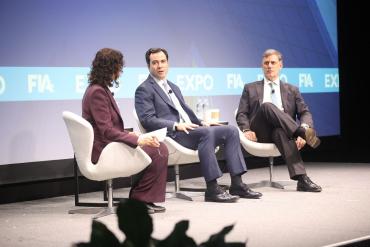
Speaking at FIA Expo on 4 November, DJ Hennes, director of the Commodity Futures Trading Commission’s market participants division and acting director of its market oversight division, described vertical integration as a relatively recent development in the US futures industry.
“This is a relatively new development, that the one corporate group has all of these registrants, the full vertical structure stack in house,” Hennes said.
Some corporate groups now include a designated contract market, derivatives clearing organization, futures commission merchant and a market maker, he said. When these structures were first proposed several years ago, “everyone was quite nervous about it.”
The CFTC is now considering whether existing conflict-of-interest rules are fit for these structures. Hennes said comments on the agency’s recent proposed rule on conflicts and affiliations raised issues including designated self-regulatory organization arrangements, external audits and the treatment of trades by affiliated market makers.
“There are already rules on the books about conflicts of interest,” Hennes said. “And this was a way for us to try and update those to make sure they are fit for purpose for this new market, this new market structure.”
In October, FIA submitted a comment letter to the CFTC that broadly supported the agency's proposals but argued that the agency should focus on affiliations that have the potential to create material conflicts of interest, rather than the existence of affiliations among registrations or market functions alone.
The association highlighted particular concerns where a registrant has regulatory or enforcement authority over competitors, where ownership of a clearinghouse creates incentives or opportunities to alter risk management to benefit an affiliate, and where a trading venue operator could give an affiliated liquidity provider a competitive advantage.
FIA’s principal recommendation was that the National Futures Association become the sole designated self-regulatory organization for all FCMs, rather than continuing to allow some exchange-operated self-regulatory organizations to carry out this function. FIA described this change as the “single most impactful reform” the CFTC could adopt to address conflicts within the self-regulatory framework.
SEC takes a closer look
Vertical integration is also attracting greater attention at the Securities and Exchange Commission, where such structures have faced greater restrictions.
“Historically we have basically not allowed it, or allowed it in extremely limited circumstances,” said Jamie Selway, director of the SEC’s trading and markets division.
The issue became more pressing this year when four registrants for securities futures perpetual products came forward, each with an introducing broker, Selway said. The SEC examined the structures and concluded that the firms could manage potential conflicts “reasonably well.”
That experience prompted the SEC to seek wider feedback, including for existing registrants that may be interested in vertically integrated structures.
“Conflicts can be managed,” Selway said. “You manage them with information controls; you manage them with disclosure.”
However, Selway acknowledged that vertical integration is newer and “probably more controversial” in securities markets because the industry is less accustomed to it.
Coordination
The agencies’ examination of vertical integration comes as the SEC and CFTC step up cooperation on products and market structures that increasingly touch both regulatory regimes.
Selway and Hennes described regular contact between their teams, including weekly meetings and work across a number of policy areas. The agencies have also held joint meetings with prospective registrants.
Selway said the difference between the current push for harmonisation and previous efforts is the degree of connection at the staff level, allowing the agencies to work through technical policy details together. Hennes said that, from his perspective, this is "the best the two agencies have coordinated".
That coordination is also evident in their approach to vertical integration. Selway said the SEC looked at the CFTC’s work on conflicts and affiliations before issuing its own staff statement seeking feedback, describing the SEC exercise as a “mini version” of the CFTC’s broader consultation.
“To the extent we need to consider some rulemaking, maybe that is a joint rulemaking, who knows,” he said.
The agencies are also considering whether firms regulated by both could eventually comply with one set of requirements in some areas. Asked whether compliance with CFTC rules could satisfy corresponding SEC requirements, Selway said the concept would be called “alternative compliance”, rather than "substituted compliance," a term associated with non-US regulation.
“It is attractive, it is a big lift,” he said.
Hennes pointed to existing precedents, including CFTC exemptions for some firms already regulated by the SEC.
Regulatory Overlap
That closer coordination is also important as new products blur traditional regulatory boundaries between securities and futures. The agencies have held joint meetings with firms that are developing new products, including a prospective perpetuals exchange, while the emergence of equity perpetuals is also prompting closer coordination on market surveillance.
Prediction markets present another example of how products can straddle regulatory boundaries. Prediction markets regulated by the CFTC have introduced event contracts on "key performance indicators" tied to specific companies such as Tesla, CoreWeave and Home Depot, while several options exchanges are seeking SEC approval to list the same type of product.
Selway admitted the SEC's process is slower than the CFTC's. "We certainly know that we need to speed up on our side because we put our exchanges through a lot."
Hennes commented that product definitions “can overlap and not be mutually exclusive”, allowing similar exposures to exist under different regulatory structures rather than forcing the agencies into a dispute over jurisdiction. He added that cross-market surveillance is "particularly timely right now with equity perps", adding that a memorandum of understanding between the agencies gives them the foundation to share the data they need.
The panel also discussed the push towards longer trading hours. US equity markets are preparing to extend trading hours to 23 hours a day, five days a week later this year. Selway cautioned that “just because you can does not mean you should”, while Hennes said the CFTC is considering extended hours asset class by asset class.
Hennes pointed to crypto at one end of the spectrum, where the underlying market already trades around the clock and collateral can move almost instantaneously. Agricultural markets, by contrast, are “not ready at this point”, he said.
On digital assets, Selway said legislation would help modernise definitions but is "not necessary". After the previous night's election results, he expects "a redoubling of our efforts" through regulation. Hennes said firms seeking to bring on-chain protocols to US customers must also close off the "back door" of Americans using VPNs to reach offshore exchanges.
Hennes closed with what he sees as the agencies' job: "Let's keep bad actors out of these markets. Let's protect customers and their money, and let's make sure there is market integrity and fairness. And I think if we get those three things right in rulemaking and how we oversee these markets, we'll have done our job."
