
The Commodity Futures Trading Commission is moving from broad discussions about financial innovation to the practical questions that will determine how new products develop in regulated US markets.
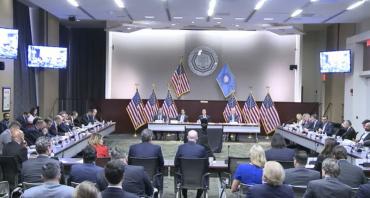
At the inaugural meeting of its Innovation Advisory Committee on 20 August, discussions ranged from federal crypto market structure and perpetual futures to round-the-clock collateral, compute derivatives and retail event contracts. Across these subjects, participants returned to a common challenge: how to support product development and market growth while maintaining resilient infrastructure, effective surveillance and customer protection.
Chaired by FIA President and CEO Walt Lukken, the committee brought together senior figures from traditional derivatives exchanges, crypto firms, decentralised finance, technology firms and prediction markets. The composition of the group reflected how far these issues have moved into mainstream derivatives market policy.
Lukken said that innovation should no longer be divided into traditional and new market categories. “When it comes to innovation, we can all agree that we must stop distinguishing between traditional and new market types.”
But he also stressed that the CFTC’s mandate to promote fair competition and responsible innovation should not come at the expense of market safety and soundness or customer protection. The committee’s purpose, he said, was to offer practical advice grounded in market experience, rather than advocate for a particular technology, business model or market participant.
Four themes that emerged from the meeting illustrate how the agency and industry are attempting to navigate the balance.
1. The CFTC is preparing for the possibility that Congress does not pass the Clarity Act
The US Congress is close to finalising the Clarity Act, a law that would establish a new framework for the regulation of digital assets. Time is running out, however, to pass the bill before the mid-term elections in November, and the odds of the bill ultimately becoming law remain uncertain.
Federal legislation remains the CFTC’s preferred route to creating a durable market structure for digital assets, but CFTC Chairman Michael Selig made clear that the agency is also examining what it could accomplish under its existing authority.
In his opening remarks, Selig said he had directed CFTC staff to explore rules that could establish a federal framework for crypto asset markets if legislation stalls.
“I’ve directed the CFTC staff to begin exploring rules to codify a CFTC market structure for crypto assets using the agency’s existing authorities.”
One possible approach, he said, could allow existing registrants and currently unregistered crypto exchanges to seek designation as a type of designated contract market, subject to rules tailored to crypto asset trading. He has also directed staff to engage with developers of on-chain financial protocols to examine how those protocols could be offered legally in the US.
These were directions to staff to explore possible rules, not an announcement that the CFTC had adopted a new crypto regime.
Legislation would provide greater durability and clarify the boundary between the CFTC and the Securities and Exchange Commission. Agency rulemaking and guidance, however, could begin addressing products and infrastructure already seeking a route into regulated US markets.
2. The onshore opportunity extends beyond crypto spot markets
The crypto discussion extended beyond market structure to topics such as perpetual futures, on-chain finance, tokenised assets and the infrastructure needed to support 24/7 markets.
Perpetual futures are derivatives without a fixed expiry date. They have become an important part of offshore crypto markets but are not widely available to US participants through regulated domestic venues.
Don Wilson, founder and chief executive of DRW, argued that the contract structure should not be equated with features such as very high leverage or automatic deleveraging used by some offshore platforms.
“Just because it is a perpetual futures contract does not mean it needs to have 100 times leverage. It does not mean it needs to have auto deleveraging. Those are features that were put in place on offshore platforms. I don't think that we should adopt those, and I've been quite clear about that,” he said.
Wilson urged the CFTC to regulate perpetual futures as futures rather than swaps and allow them across a wider range of underlying products.
“If we categorise them as swaps, they are just going to remain offshore. We will not be able to benefit from the risk management tools that these can provide if we bring them onshore into a safe and regulated environment,” he said.
The discussion also highlighted the infrastructure needed to support markets operating beyond conventional trading hours.
“We’re moving to 24/7 trading. We obviously need to facilitate 24/7 collateral movement,” Wilson said.
Participants raised related questions about tokenised customer assets, custody and segregation, eligible depositories, margin cycles and cross-product margining.
Bringing products developed primarily offshore into regulated US markets would involve more than authorising new contracts. Banking, custody, clearing and collateral arrangements would also need to evolve to support them, participants said.
3. Compute is emerging as a derivatives market
Among the meeting's more forward-looking themes was the emergence of compute as a potential underlying market for derivatives and risk management products.
The day before the meeting, the CFTC issued a request for comment on the listing of compute derivatives. The consultation seeks information on compute cash markets, liquidity, oversight, manipulation, customer protection and perpetual compute futures. The request for comment is an information-gathering exercise, not a final rule or completed regulatory framework.
Participants described a growing demand from AI developers and data centre operators for products that could help manage uncertainty over future compute costs and availability.
The discussion also highlighted a familiar challenge for derivatives markets: before exchanges can build viable contracts, the underlying market must be capable of supporting reliable price discovery and settlement. Several participants raised questions about the maturity of compute cash markets and whether they are sufficiently standardised, liquid and transparent to support robust derivatives.
Some committee members argued that compute derivatives may require greater regulatory flexibility while the market is still developing. They suggested safe harbours or innovation exemptions that would allow new products to be tested before being rolled out more broadly.
Wilson took a different view, arguing that existing CFTC listing processes should be capable of accommodating the products where exchanges can demonstrate robust pricing and market integrity.
“I don’t think we need to reinvent the wheel here just because we have a new technology and a new market, said Wilson, whose firm is backing one of the companies that has developed an index tracking compute rental pricing.
4. Prediction market growth is intensifying scrutiny of surveillance and product governance
Prediction markets generated the meeting’s sharpest disagreement.
The CFTC has proposed amendments to Regulation 40.11 that would establish a framework for assessing event contracts involving war, terrorism, assassination, gaming or unlawful activity, and whether those contracts are contrary to the public interest. The proposal would define key terms and establish a contract review process.
Selig said he expected the Commission to propose further amendments to Parts 38 and 40 covering listing rules, product governance, market design, incentive programmes and retail customer protection.
Terry Duffy, chairman and chief executive of CME Group, warned that event contracts vulnerable to manipulation could damage confidence in the wider derivatives industry.
“The best way to ruin a market – and I guess I’m old enough to recall in 2008 and 2009 – when the financial industry takes bad behaviour, it doesn’t take a step backwards. It takes 20. It takes years to respond and build back the financial system. We have been able to do that, and I hope we don't go backwards again,” he said.
Prediction market executives countered that manipulation risk is not unique to event contracts. Luana Lopes Lara, co-founder of Kalshi, argued that the role of regulation was to identify and address those risks rather than assume emerging markets would operate without them.
“Every market has risk and every nascent market will have risks as well,” she said.
The discussion also highlighted concerns about consistency in retail protections. Several participants argued that standards such as know-your-customer requirements should be applied more consistently across different access models.
Lukken captured the point of common ground at the close of the session: “Nobody wants contracts to be able to be manipulated in our markets.”
Market structure
Across crypto assets, compute derivatives and prediction markets, the discussion repeatedly returned to questions of market structure, infrastructure and oversight.
The challenges differ: Perpetual futures require appropriate leverage and risk controls. Continuous trading depends on collateral, clearing and banking infrastructure capable of operating beyond conventional market hours. Compute derivatives need reliable underlying markets and reference prices, and prediction markets require credible surveillance, product governance and consistent protections for retail customers.
These are familiar challenges for derivatives markets. The difference is that they now apply to a widening range of products, technologies and market participants.
View the full IAC meeting here.
