
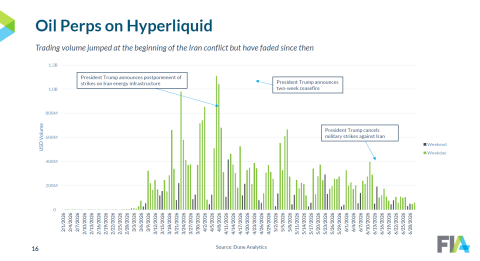
When geopolitical news broke over a weekend, Hyperliquid’s oil perpetuals remained available while the primary futures markets were closed.
The contracts, traded on a decentralised venue built on its own blockchain, offer one example of a broader shift towards derivatives products that are available for longer, expire sooner or represent smaller amounts of exposure.
At the other end of the duration spectrum, zero-day options, or 0DTEs, expire on the day they are traded. They account for more than half of the volume in the major S&P 500 and Nasdaq 100 index and ETF options according to a recent Cboe industry report. Meanwhile, volume in micro contracts, such as CME Group’s Micro WTI futures, have risen exponentially this year.
These trends were among those examined during FIA’s recent webinar on volume and open interest in global exchange-traded derivatives markets during the first half of the year. The products have developed in different markets and do not serve identical purposes, but what connects them all is greater flexibility for investors over when to trade, how long to hold an exposure and how much risk to take.
Trading around the clock
Trading in crude oil perpetuals on Hyperliquid jumped as market participants responded to developments in the conflict involving Iran earlier this year. Unlike conventional futures, perpetuals have no fixed expiry, allowing positions to remain open if the trader meets the venue’s requirements.
“This drew a lot of attention in the first quarter when people realised it was possible to trade oil futures – maybe not the kind we’re used to, but still an oil future – on the weekends,” said Will Acworth, FIA’s global head of market intelligence. “This then allowed people to react more or less in real time to developments in the war, as well as to comments being made by President Trump on his Truth Social platform.”
Interest surged when the war broke out in April, but Acworth said it has tailed off since then. “It is a significant amount of trading, no doubt about it. But it’s interesting to see that it’s actually smaller than what happens [on the Hyperliquid platform] during the week, which is also when the primary markets are open.”
Guy Wolf, global head of market analytics at Marex, compared perpetuals with weekend markets already offered on stock indices by spread-betting firms, where bid-offer spreads can be wide.
The growth of perpetual futures has also intensified debate about their implications for exstablished markets. Acworth said commercial market participants have expressed concerns about the potential impact of perpetuals on liquidity and the quality of price discovery, as well as pressure on traditional markets to introduce weekend trading.
Regulators are scrutinising the contracts too. The CFTC has sought public comment on perpetual contracts linked to physical energy commodities and on extending standard futures to 24/7 trading. Its questions cover the implications for reference prices, market surveillance, margin, clearing and settlement, physical markets and commercial market users.
Not everyone expects perpetuals simply to take business from existing contracts. Acworth argued that new markets can complement established ones by supporting different hedges and trading strategies and creating arbitrage opportunities. Whether that pattern will extend to perpetual futures, he said, remains uncertain.
Trading for less time
Perpetual futures remove a fixed expiry. Zero-day options take the opposite approach, compressing an exposure into a single trading session.
More than half of the volume in the major S&P 500 and Nasdaq 100 index and ETF options this year has been in contracts expiring on the day of the trade. The figures came from a Cboe industry report on the US options market and include cash-index products and ETF options traded across US exchanges.
The term 0DTE refers to an option on its final trading day, rather than necessarily to a separate product. What has changed is the availability of expiries across every trading day in leading index and ETF options, giving participants regular access to contracts with only hours left to run.
“This is truly a structural shift in how the US equity index options market operates,” Acworth said.
The scale is visible in FIA’s first-half rankings. Trading in Cboe’s SPX options reached 613.5 million contracts, up 38% from a year earlier. SPDR S&P 500 ETF options recorded 1.42 billion contracts, an increase of 19.8%, while options on the QQQ ETF rose 49.8% to 813.7 million.
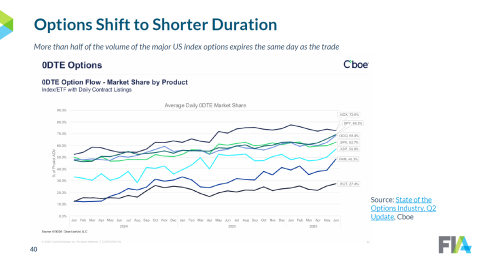
Same-day options can be used for hedging or speculation. Whatever the motivation, daily expiries have concentrated a substantial share of activity at the shortest end of the options market.
Trading smaller
Meanwhile, micro and mini contracts are reducing the amount of exposure represented by each trade.
CME Group’s Micro WTI future represents 100 barrels, compared with 1,000 barrels for its standard WTI contract. Almost 35 million Micro WTI contracts traded in the first half of 2026, up 264.5% from a year earlier. Open interest at the end of June rose 89.9% to 47,048 contracts.
Smaller products are also growing in equity and precious metals markets. Micro E-mini Nasdaq 100 futures volume rose 27.9% to 279.3 million contracts, while one-gram Gold Petal futures on India’s Multi Commodity Exchange recorded 41.5 million contracts, an increase of 1,119.8%. COMEX E-Micro Gold futures rose 345% to 36.5 million contracts.
For Wolf, those increases form part of a wider expansion in retail access.
“The rise of retail has clearly been a major theme over many markets over recent years,” he said, pointing to the growth of smaller precious metals products. “It is definitely that sort of Robinhood-style retail democratisation of access to markets showing up in commodities as well.”
Regulation meets product innovation
India shows how the development of new products can complicate attempts to curb speculative activity.
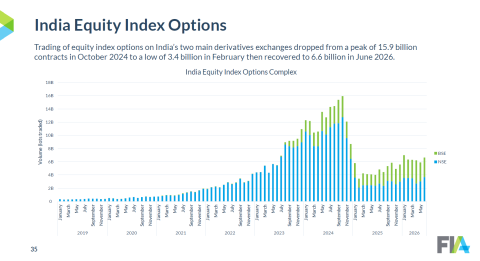
Regulators tightened rules governing equity index derivatives after a study found that nine out of 10 retail participants lost money. The measures included higher upfront margins, larger contract sizes and fewer weekly expiries.
Trading of equity index options on India’s two main derivatives exchanges, National Stock Exchange of India and Bombay Stock Exchange, fell from a peak of 15.9 billion contracts in October 2024 to 3.4 billion in February, before recovering to 6.6 billion in June 2026, according to FIA data.
At the same time, smaller commodity products expanded rapidly. Crude oil mini options on India’s Multi Commodity Exchange recorded 584.1 million contracts in the first half, up 1,539.7%, while natural gas mini options rose 855.8% to 147.1 million contracts.
Acworth likened the pattern to “squeezing the balloon”, with retail activity appearing to increase in other asset classes as regulators constrained parts of the equity options market.
FIA’s data does not establish that the same traders moved from equity options into commodity contracts. The contrasting trends nevertheless illustrate how quickly activity can develop in smaller products elsewhere.
Perpetual futures, zero-day options and micro contracts are not aimed at identical users and do not raise the same market structure questions. But while the products may differ, each is giving traders more choice over defining features of a derivatives position: when to trade, for how long, and in what size.
Watch the webinar in full here.
View the data here.
